
The activities of authorised agencies such as police, customs, border services, and investigative bodies to enforce drug control laws and address criminal activities related to the production, trafficking, and distribution of illicit substances. These activities may include investigations, intelligence gathering, interdiction, and collaboration with national and international partners to disrupt organised crime networks. Law enforcement plays an important role in protecting public safety and maintaining the rule of law, and is most effective when coordinated with broader public health, prevention, treatment, and recovery efforts as part of a balanced and comprehensive response to substance use.
Law Enforcement
Effectiveness Bank Course on Alcohol Treatment Research Reaches its Conclusion
COURSE ON ALCOHOL TREATMENT RESEARCH REACHES ITS CONCLUSION Time to recap the journey started over a year ago to update the Alcohol Treatment Matrix, a unique mapping of seminal and key research and guidance on alcohol brief interventions...
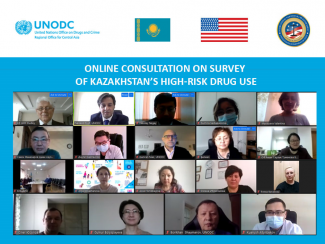
UNODC Presents the Concept of the Survey of Kazakhstan’s High-Risk Drug Use
4 March 2021, Online Consultation on initiation of the Survey in Kazakhstan on High-Risk Drug Use took place via Zoom Teleconference Platform. More than 25 representatives of governmental, non-governmental stakeholders in the Republic of...
Plan for the opening of the National Unit of the International Society of Substance Use Professionals (ISSUP) Kazakhstan
The ISSUP Kazakhstan team is pleased to welcome you to the upcoming opening ceremony of the National Unit of the International Society of Substance Use Professionals (ISSUP) Kazakhstan, which will be held online April 14, 2021 at 10:00 a.m...
Why is the record so poor? Highlight from Effectiveness Bank Alcohol Treatment Matrix row 5
See this message as a web page: WHY IS THE RECORD SO POOR? The first cell of row 5 presented a catalogue of negative evaluations of attempts to treat problem drinking among sentenced offenders in Britain, a record also seen internationally...
India/Nagaland: ‘Culture of acceptance responsible for substance abuse’
By Menuse-O Max Khieya, first published in the Eastern Mirror Nagaland on Sunday, March 14, 2021 Sechü-Zubza, March 14 (EMN): The additional deputy commissioner of Kohima, N Bhavani Sri, has expressed concern over the widespread abuse of...
Canadian Bill Tabled to Relax Drug Possession Penalties
Legislation in Canada introduced Bill C22, which would ease penalties for drug crimes such as possession and replace mandatory minimum penalties. The Canadian government stated drug crimes disproportionately harm black and indigenous...
Beyond the Patient: Treatment’s Impacts on Family and Community. Effectiveness Bank Alcohol Treatment Matrix, Row 5
View this message as a web page BEYOND THE PATIENT: TREATMENT’S IMPACTS ON FAMILY AND COMMUNITY Time to consolidate the lessons of row 5 of the Alcohol Treatment Matrix. This final row defocused from the patient to ask what treatment can do...
UNODC and partners discuss situation with New Psychoactive Substances in Kyrgyzstan
New psychoactive substances (NPS) are spreading at an unprecedented rate and are becoming a serious health threat and a real problem in drug policy in Central Asian countries. Little is known about the negative impact of NPS on human health...
A Scoping Review of Factors that Influence Opioid Overdose Prevention for Justice-Involved Populations
Abstract Background There is a high risk of death from opioid overdose following release from prison. Efforts to develop and implement overdose prevention programs for justice-involved populations have increased in recent years. An...
Organisations Set the Context for Crime-Reducing Treatment. Effectiveness Bank Alcohol Treatment Matrix, Cell D5
ORGANISATIONS SET THE CONTEXT FOR CRIME-REDUCING TREATMENT Key studies teasing out organisational-level influences on treatment for drinking problems which aims to reduce crime and safeguard family and community. In the context of a market...