
The activities of authorised agencies such as police, customs, border services, and investigative bodies to enforce drug control laws and address criminal activities related to the production, trafficking, and distribution of illicit substances. These activities may include investigations, intelligence gathering, interdiction, and collaboration with national and international partners to disrupt organised crime networks. Law enforcement plays an important role in protecting public safety and maintaining the rule of law, and is most effective when coordinated with broader public health, prevention, treatment, and recovery efforts as part of a balanced and comprehensive response to substance use.
Law Enforcement
The Role of Law Enforcement Officers in Drug Use Prevention within School Settings A Guiding Document
In the context of law enforcement, the UNODC has developed a guiding document to help support a change of culture on how to make use of the science of prevention for the betterment of the health and safety development of youth. The UNODC...
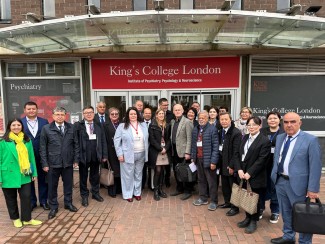
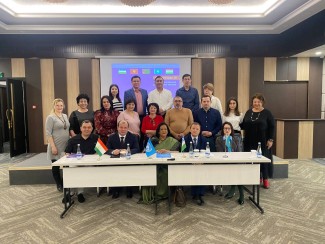
UNODC supported delegations from four Central Asian countries in a high-level study tour to the United Kingdom
The UNODC Regional Office for Central Asia (ROCA) together with the UNODC Prevention, Treatment and Rehabilitation Section (PTRS) organized a study tour for high-level representatives, including senior officials, policymakers and substance...
Hexahydrocannabinol (HHC) and related substances
Introduction The markets for hexahydrocannabinol (HHC) and related semi-synthetic cannabinoids (SSC) are rapidly evolving areas with relatively limited information currently available. The European situation presented in Section 1 can only...
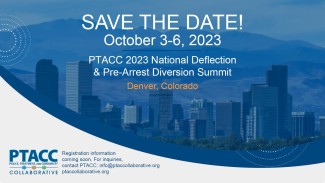
PTACC Annual Deflection Summit Call for International Presenters
Proposals are now being accepted for the 2023 Police, Treatment, and Community Collaborative’s (PTACC) National Deflection and Pre-arrest Diversion Summit. All submissions must be uploaded by May 5, 2023 at 2:00 EDT in order to be...
Human rights issues associated with compulsory drug treatments and rehabilitation process in Sri Lanka
Compulsory drug treatment and rehabilitation: Human Rights issues in Sri Lanka K.A. WARUNI KUMARASINGHA, Assistant Lecturer, Department of International Studies, University of Kelaniya, Sri Lanka Abstract Protection of human rights is a...
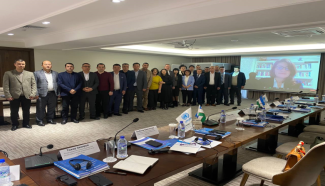
National policymakers and key stakeholders in Central Asia increase their knowledge of the quality assurance system related to drug use disorders through UNODC trainings
The UNODC Regional Office for Central Asia (ROCA) conducted a series of national trainings on "Quality Assurance (QA) of Drug Use Disorder Treatment Systems", which took place from 27 to 28 February 2023 in Tashkent, Uzbekistan, from 2 to 3...
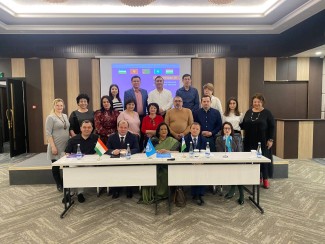
UNODC improves clinical and group skills of a team of national trainers from Central Asia
The UNODC Regional Office for Central Asia supported the training for trainers on course 16 – "Advanced Clinical Skills" and on course 19 – "Strengthening group skills", which took place in Tashkent, Uzbekistan, on 20-24 February 2023...
UNODC Enhanced Clinical and Group Facilitation Skills of the Team of National Trainers from Central Asia
The UNODC Regional Office for Central Asia supported a training of trainers (ToT) on “Course 16 – Advanced Clinical Skills “and “Course 19 – “Enhancing Group Facilitation Skills” which took place in person in Tashkent, Uzbekistan on 20-24...
Early Prevention of Drug Use: Understanding and implementing the UNODC/WHO International Standards on Drug Use Prevention for Effective Prevention Strategies and a Healthy and Safe Child Development
ISSUP Namibia in collaboration with UNODC are pleased to present their Webinar on Early Prevention of Drug Use: Understanding and implementing the UNODC/WHO International Standards on Drug Use Prevention for Effective Prevention Strategies and a Healthy and Safe Child Development.
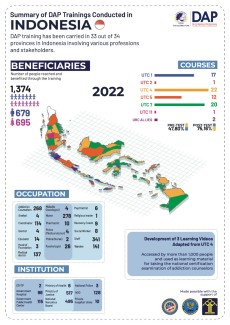
The Colombo Plan Drug Advisory Program Conducted Training in Indonesia on 2022
The Collaboration of the Colombo Plan Drug Advisory Programme (CPDAP) with government partners and stakeholders in Indonesia in 2022 has resulted in 73 basic and advanced UTC training courses, 2 (two) training on the URC-ALLIES model which...