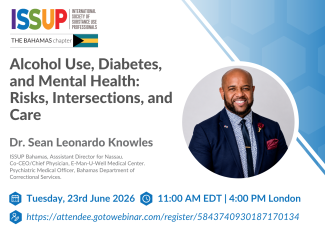
ISSUP Bahamas would like to invite you to its maiden webinar. This webinar will focus on the topic, "Alcohol Use, Diabetes, and Mental Health: Risks, Intersections, and Care."
Kloučková, K. & Barták, M. (2025). Alcohol Labelling: Czech Expert Perspectives and Recommendations. Adiktologie, 25(4), 181–190
INTRODUCTION: Consumption of alcohol has significant influence on the physical and mental health of the Czech population. Nevertheless, public awareness of alcohol-related consequences in the Czech Republic remains inadequate. One potential and promising strategy for increasing awareness and promoting prevention is the labelling of
alcoholic
beverages, which could serve as an educational tool for consumers. The aim of the present study was to find positive or negative consensus among experts in the Czech Republic regarding statements and recommendations on alcohol labelling and its potential...
A new chapter in training has begun at ISSUP. A new Training Team has been formed with the goal of improving the accessibility and relevance of ISSUP’s training, while ensuring it reflects the learning needs of members worldwide.
In the early months of its work, the team carried out a training needs assessment to better understand members’ online learning needs. At the same time, the team engaged with several Learning Management System (LMS) providers to explore options for a new platform that supports accessible, high-quality learning. The proposals received are now being reviewed.
The ESPAD report presents the results of the eighth data-collection wave, which took place in 2024, and marks an impressive 30 years of data collection by this long-standing collaboration. More than 113 000 15- to 16-year-old students from 37 countries, including 25 EU Member States, took part. Since 1995, over 800 000 students have contributed, making ESPAD the most extensive harmonised data collection on substance use and risk behaviours in Europe, and the largest cross- national research project on adolescent substance use worldwide.
The Canadian Centre on Substance Use and
Addiction
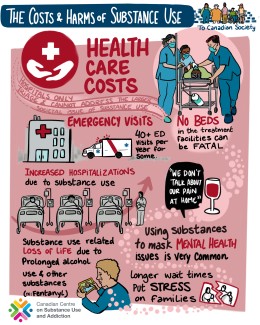
(CCSA) transforms complex data into insights that reflect real human experiences. Every aspect of the Canadian Substance Use Cost and Harms (CSUCH) project represents individuals with lived or living experience of substance use, along with their families, workplaces, and communities.
A new resource highlights these journeys and the human cost of substance use through illustrated stories from people with
lived experience
and their families. The illustrations cover three key areas of the CSUCH project: healthcare, lost productivity, and...
The 2025 Annual Report to the Parliament on Drug Addictions in Italy offers a comprehensive overview of the current drug
addiction
landscape. Despite a slight decline in youth drug use for the first time since 2018, the report highlights ongoing challenges, particularly with substances like cocaine, synthetic opioids, and high-potency cannabis derivatives. Law enforcement and judicial efforts remain strong, and Italy continues to be a key collaborator in global anti-drug initiatives, particularly with countries in South America and the Indo-Pacific region.
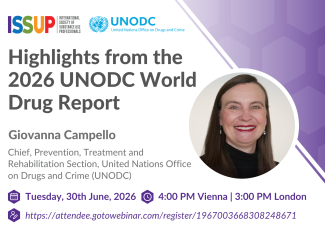
ISSUP in collaboration with UNODC present a webinar highlighting key findings from the 2025 edition of the UNODC World Drug Report. The session is presented by Giovanna Campello, Chief of the Prevention,
Treatment
and
Rehabilitation
Section at the United Nations Office on Drugs and Crime (UNODC).
ISSUP, in collaboration with Faces & Voices of Recovery, has launched a new Global Recovery Network webinar series to spotlight diverse perspectives on recovery. The first webinar featured Dr. Haner Hernández, a respected expert in the field and a person in long-term recovery. Dr. Hernández currently serves as a Senior Consultant to the Massachusetts Department of Public Health and plays a key role in advancing health equity, workforce development, and recovery support. His presentation provided an insightful and inclusive overview of multiple pathways to recovery, grounded in both...
Join our upcoming webinar highlighting key findings from the 2025 edition of the UNODC World Drug Report. The session will be presented by Giovanna Campello, Chief of the Prevention,
Treatment
and
Rehabilitation
Section at the United Nations Office on Drugs and Crime (UNODC).
The WHO Global Status Report on Alcohol and Health and
Treatment
of Substance Use Disorders provides a comprehensive snapshot of global trends in alcohol consumption, related harms, and national policy responses, alongside the availability and quality of treatment services for alcohol and drug use disorders.
Key Highlights:
Presents the latest data from WHO Member States, aligned with SDG Health Target 3.5: “Strengthen prevention and treatment of
substance abuse
, including narcotic
drug abuse
and harmful use of alcohol.”
Offers updated insights on global alcohol consumption patterns...
A global reference on drug markets, trends and policy developments, the World Drug Report offers a wealth of data and analysis and in 2025 comprises several elements tailored to different audiences.
ISSUP Greece and ISSUP Kazakhstan cordially invite you to a presentation of the results from an online study on alcohol use among adults in Greece and Kazakhstan.
This publication presents key findings from the 8th round of the European School Survey Project on
Alcohol and Other Drugs
(ESPAD), conducted in 2024 among 113,882 students aged 15–16 across 37 European countries.
Marking 30 years of monitoring adolescent risk behaviours, the 2024 edition introduces a new focus on mental well-being and prevention activities, highlighting their growing role in shaping youth health outcomes.
The key findings report is available in 33 languages and optimised for online access. A full report, ESPAD Report 2024, will be released in October 2025.
This practical and up-to-date guide offers comprehensive support for primary care clinicians managing patients with substance use disorders. Covering a wide range of substances and clinical scenarios, the book is organized into four parts: foundational knowledge, specific substance dependencies, clinical management (diagnosis,
treatment
,
recovery
), and considerations for special groups such as women, adolescents, and individuals with co-occurring disorders.
An essential resource for physicians, nurse practitioners, medical students, and
addiction
specialists.
A new study from the University of Dundee and University of Stirling highlights the impact of placing specialist
Addiction
Nurses (ANs) within primary care teams to support individuals with serious alcohol problems in disadvantaged communities. Focusing on a service in Glasgow (PCANOS), the research shows how ANs deliver person-centred care through home visits, building trust and improving health outcomes.
Patients reported reduced alcohol use, better well-being, and stronger family relationships. The study emphasises the importance of expanding the role of ANs to reach underserved...
Thom, B., Annand, F., Clancy, C., Whittaker, A., & Janiszewska, I. (2023). The role of UK alcohol and drug (AOD) nurses in a changing workforce. Drugs: Education, Prevention and Policy, 31(6), 616–624. https://doi.org/10.1080/09687637.2023.2266554
Background:
This article shares findings from a study that looked into how
alcohol and other drugs
(AOD) nurses in the UK view their current career opportunities and the challenges they face. It also explores how changes in health services have affected their roles.
Methods:
Researchers conducted interviews with twelve AOD nurses using a narrative approach to allow for open discussion and new insights. The interviews were recorded, transcribed, and analyzed to identify common themes.
Key Findings:
Nurses discussed the pros and cons of non-medical prescribing (NMP) and how it has...
This brief examines the average alcohol consumption of people in Canada and where it falls within the risk zones outlined in Canada’s Guidance on Alcohol and Health (CGAH). The publication presents updated data on weekly drinking patterns by province, age, and sex, and assesses the extent to which people in Canada adhere to the CGAH guidelines. This report is intended to inform public health professionals, policy makers and researchers working to reduce alcohol-related harm.
Three Key Points You Will Find in the Document:
People who drink alcohol in Canada consume an average of more than13...
CSUCH’s data visualisation tool can be used to estimate substance use trends across the country. The data helps inform programs, practices, and research to protect communities, save lives, and improve the well-being of people in Canada.
Spotlight: Top 3 causes of death due to substance use in Canada
More than 200 people died each day due to substance use (SU) in 2020 (the latest year for which data are available). That works out to 73,994 deaths that year. The average age of death due to SU was 45 years. Tobacco use caused 63% (46,366) of SU-related deaths, followed by alcohol at 23%...
Cofresí, R.U., Piasecki, T.M. & Bartholow, B.D. Alcohol insensitivity and the incentive salience of alcohol: Two decades of work relevant to future directions of the addictions neuroclinical assessment. Transl Psychiatry 15, 50 (2025). https://doi.org/10.1038/s41398-025-03273-y
In a recent article, Gunawan and colleagues explore how the Incentive Salience (IS) domain in the Addictions Neuroclinical Assessment (ANA) framework relates to alcohol motivation and alcohol insensitivity. Their findings support previous research suggesting a connection between alcohol insensitivity and the motivation-driven response to alcohol-related cues. This review highlights the importance of understanding how individuals with low alcohol sensitivity (LS) experience stronger reactions to alcohol cues compared to those with high alcohol sensitivity (HS). It also emphasizes the need for...