
From Case to Care: Courts as a Turning Point: Judicial Responses to Substance Use and Drug-Related Offending
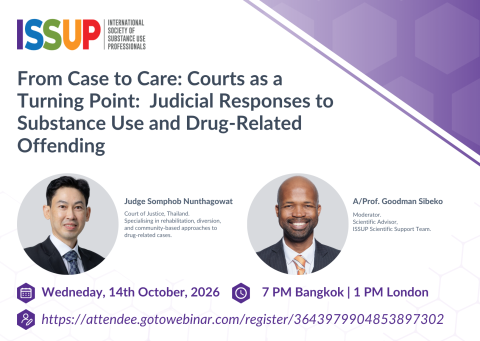
ISSUP Global presents a webinar on 'Judicial Responses to Substance Use and Drug-Related Offending'
Date: Wednesday, 14th October, 2026
Time: 7 PM Bangkok | 1 PM London
Courts regularly encounter people whose offending is closely linked to substance use disorders. This webinar will examine how courts can serve as turning points by connecting eligible individuals with evidence-based treatment and community support while maintaining due process, judicial independence, accountability, and public safety.
Drawing on Thailand’ s court-based experience and relevant international practice, the moderated discussion will consider why traditional court processing may be insufficient; how court-based alternatives can be designed with appropriate legal and ethical safeguards; including individualized assessment, proportionality, procedural fairness, and respect for the rights and interest of victims; the partnerships required among courts, probation, treatment, health, and social services; and how outcomes can be assessed beyond conviction rates, including treatment engagement, recovery, reduced reoffending, and community safety.
Intended audience:
- Judges, magistrates, judicial officers and court administrators; prosecutors and defence practitioners; probation, corrections and law-enforcement professionals; substance use treatment, recovery, mental-health and social-service professionals; policymakers; researchers and students; civil-society organisations; and ISSUP members working across treatment, recovery and criminal justice.
Learning outcomes:
By the end of the webinar, participants will:
-
Describe how courts can respond to substance-related offending through evidence-informed judicial practice.
-
Explain how court-based responses can balance accountability, procedural fairness, public safety and access to treatment.
-
identify the justice, health and community partnerships required for effective court-based alternatives to incarceration.
-
Discuss measures of success beyond traditional criminal justice outcomes, including treatment engagement, recovery and reduced reoffending.
-
Identify practical considerations for adapting judicial innovations across different legal and cultural settings.
Presenter:
Judge Somphob Nunthagowat
Court of Justice, Thailand
Somphob Nunthagowat is a Thai judge serving in the Research Division of the Supreme Court of Thailand. He is assigned to advance rehabilitation and resocialization initiatives, integrating psychosocial counselling and community-based treatment into judicial processes as alternatives to imprisonment. He contributes to the development of pilot court programs and diversion measures that direct people who use drugs towards healthcare and is involved in drafting and submitting legislative proposals aimed at supporting social rehabilitation and reducing recidivism. He also speaks to judges, justice sector agencies, and health professionals on offender reintegration through multidisciplinary collaboration.
Moderator:
A/Prof. Goodman Sibeko
Scientific Advisor, ISSUP
Associate Professor Ntokozo Goodman Sibeko works in public mental health and addiction psychiatry at the University of Cape Town and serves as Scientific Advisor to ISSUP. His work includes strengthening the professional workforce across substance use prevention, treatment and recovery through evidence-informed policy, practice and international knowledge exchange.
References
-
United Nations Office on Drugs and Crime and World Health Organization. (2018). Treatment and care for people with drug use disorders in contact with the criminal justice system: Alternatives to conviction or punishment.
-
United Nations Office on Drugs and Crime and World Health Organization. (2020). International Standards for the Treatment of Drug Use Disorders.
-
United Nations Office on Drugs and Crime. (2007). Handbook of Basic Principles and Promising Practices on Alternatives to Imprisonment.
-
ISSUP. (2024). ATI Basics webinar series and Alternatives to Incarceration reading list.
Webinars and online events delivered and hosted by the International Society of Substance Use Professionals (ISSUP) are provided for informational purposes only. They are educational in nature and do not constitute medical advice, diagnosis or treatment.
- ISSUP members can join Networks to comment – Sign in or become a member