
Bromazolam: The "Designer Xanax" Behind Fake Bars, Now Schedule I
Last Updated: July 24, 2026
Quick answer: Bromazolam is a “designer” benzodiazepine never approved for medical use in any country. It is the ingredient most often found in counterfeit Xanax bars, and it is increasingly mixed with fentanyl in street drug supplies. On March 18, 2026, the DEA emergency-scheduled bromazolam into Schedule I, citing a rapidly evolving threat to public safety.
Key takeaways
- Bromazolam has never been approved for medical use in the United States or any other country.
- The DEA placed bromazolam in Schedule I on March 18, 2026 through an emergency temporary scheduling order.
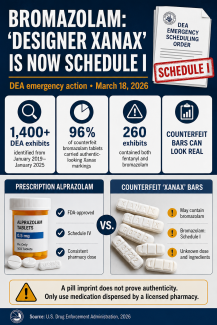
- It is most commonly sold as counterfeit Xanax: 96% of counterfeit tablets containing bromazolam carry authentic Xanax markings such as B 707, GG 249, and R 039.
- DEA laboratories identified bromazolam in more than 1,400 exhibits between January 2019 and January 2025 — over 1,000 of them in tablet form.
- Bromazolam is appearing alongside fentanyl (“benzo dope”): 260 DEA powder exhibits contained both drugs.
- Because bromazolam acts on non-opioid receptors, it can complicate overdose reversal when combined with opioids.
- Kilogram quantities of bromazolam powder — and Xanax-imprint pill-press molds — are openly sold by China- and India-based chemical suppliers online.
On this page
- What Is Bromazolam?
- Fake Xanax Bars
- Real vs. Counterfeit
- Bromazolam + Fentanyl
- DEA Emergency Scheduling
- Regulatory Timeline
- Effects & Risks
- Where to Find Help
- FAQ
What Is Bromazolam?
Bromazolam is a synthetic benzodiazepine first developed decades ago but never brought to market as a medicine. Unlike prescription benzodiazepines such as alprazolam (Xanax), diazepam (Valium), or clonazepam (Klonopin) — which are FDA-approved and regulated mostly under Schedule IV — bromazolam existed until 2026 in a legal gray zone: unapproved, unregulated, and easy for overseas chemical suppliers to sell in bulk.
That gray zone made it attractive to counterfeiters. A November 2025 DEA bulletin documented multiple China- and India-based suppliers openly offering kilogram quantities of bromazolam powder on business-to-business platforms, along with pill-press die molds that stamp fake tablets with authentic Xanax imprints.
The Counterfeit Xanax Connection
Bromazolam’s primary role in the illicit market is impersonating alprazolam. According to DEA forensic data, bromazolam is “most commonly used as an active ingredient in counterfeit Xanax tablets,” and 96% of counterfeit tablets containing it bear markings copied from real Xanax products — imprints such as B 707, S 903, V 2090, R 039, and GG 249.
Between January 2019 and January 2025, DEA laboratory systems identified bromazolam in more than 1,400 exhibits, over 1,000 of them tablets. A person buying “Xanax bars” from a dealer or social media source has no way to distinguish these fakes by sight. For a full guide to authentic bar types, colors, imprints, and street slang, see Xanax Bars: Types, Colors, Slang, Risks & Treatment.
Prescription Alprazolam vs. Counterfeit “Bars”
| Prescription alprazolam (Xanax) | Counterfeit “Xanax” bars | |
|---|---|---|
| Active ingredient | Alprazolam, FDA-approved, precise dose | Often bromazolam; sometimes fentanyl or other substances |
| Legal status | Schedule IV, prescription only | Contains Schedule I bromazolam (as of March 2026) |
| Dose consistency | Uniform, pharmaceutical manufacturing | Unknown; varies pill to pill, even within one batch |
| Source | Licensed pharmacy | Pressed from bulk powder using copied imprint molds |
| Appearance | Standardized imprints (e.g., GG 249, B 707) | Same imprints, deliberately copied — visually indistinguishable |
📌 Key insight: The imprint on a “Xanax bar” proves nothing. Counterfeiters buy die molds that replicate authentic markings exactly — the DEA found that 96% of bromazolam tablets carry real Xanax imprints. The only pill that is verifiably alprazolam is one dispensed by a licensed pharmacy.
“Benzo Dope”: Bromazolam Plus Fentanyl
Bromazolam increasingly appears mixed with opioids. DEA laboratories found 260 powder exhibits containing both fentanyl and bromazolam, along with counterfeit tablets containing both. Traffickers reportedly add the benzodiazepine because its sedative action on non-opioid receptors gives users “the perception of a longer high.”
The clinical problem: naloxone reverses opioid effects but does not act on benzodiazepine receptors. A person who has taken bromazolam-adulterated fentanyl may remain deeply sedated even after naloxone is given — a scenario that complicates emergency response and has been reported across North American drug supplies.
The DEA’s Emergency Scheduling
On March 18, 2026, the DEA announced emergency temporary scheduling of bromazolam into Schedule I — the category for substances with no accepted medical use and high abuse potential. Announcing the action, DEA Assistant Administrator Cheri Oz said: “The emergency scheduling of bromazolam is a decisive step to get ahead of a rapidly evolving threat. We will not wait for more lives to be put at risk.”
The move followed sustained pressure from the states: in August 2025, 21 state attorneys general formally urged the DEA to schedule the drug, with Oklahoma’s attorney general publicly campaigning against “designer Xanax.” The pattern mirrors the agency’s July 2026 action on concentrated kratom alkaloids — covered in DEA Announces Temporary Schedule I Control of 7-OH, Mitragynine Pseudoindoxyl, MGM-15, and MGM-16 — in which emergency authority was used to move ahead of an emerging synthetic threat rather than after it peaked.
Regulatory timeline
| Date | Event |
|---|---|
| Jan 2019 – Jan 2025 | DEA labs identify bromazolam in 1,400+ exhibits, most in counterfeit tablet form |
| 2024 | FDA recommends bromazolam for international control under U.N. convention |
| Aug 2025 | 21 state attorneys general petition DEA to schedule “designer Xanax” |
| Nov 2025 | DEA bulletin documents open online sales of bulk powder and Xanax-imprint press molds |
| Mar 18, 2026 | DEA emergency-schedules bromazolam into Schedule I |
Effects and Risks
Bromazolam produces classic benzodiazepine effects — sedation, slurred speech, loss of motor control (ataxia), altered mental state — but with no established human dosing, effects are unpredictable. The most serious risks are respiratory depression, especially when combined with opioids or alcohol, and dependence with a benzodiazepine withdrawal syndrome that can be medically serious and should not be managed alone.
Myth vs. fact
| Common belief | Reality |
|---|---|
| “It has a real Xanax imprint, so it’s real.” | 96% of bromazolam counterfeits carry authentic Xanax markings. |
| “Bromazolam is just weaker Xanax.” | It was never tested or approved for humans; dose and effects are unpredictable. |
| “Naloxone will fix any overdose.” | Naloxone does not reverse benzodiazepines; sedation can persist after opioid reversal. |
| “If it were dangerous, it would have been illegal already.” | It sat in a regulatory gap until the DEA’s March 2026 emergency action. |
Where to Find Help
Benzodiazepine dependence — whether from prescription alprazolam or counterfeit bars — deserves professional evaluation, because abrupt discontinuation can be dangerous. Anyone experiencing a medical emergency should call 911. For education, helpline support, and treatment navigation, resources such as and can help individuals and families find appropriate care. The U.S. SAMHSA National Helpline (1-800-662-4357) is free and confidential.
Frequently Asked Questions
Is bromazolam illegal now?
Yes — bromazolam is now illegal in the United States. The DEA placed bromazolam into Schedule I of the Controlled Substances Act by emergency temporary order on March 18, 2026. Schedule I is the most restrictive category, reserved for substances with no currently accepted medical use and a high potential for abuse. Before this order, bromazolam sat in a legal gray zone: it was never an approved medicine, but it also was not a scheduled substance, which allowed overseas suppliers to sell it openly. The emergency order closes that gap while the DEA pursues permanent scheduling.
What is “designer Xanax”?
“Designer Xanax” is the street and media term for unapproved benzodiazepines — chiefly bromazolam — pressed into counterfeit tablets that copy authentic Xanax shapes, colors, and imprints. The term gained national attention in August 2025, when 21 state attorneys general used it in a formal letter urging the DEA to schedule bromazolam. Unlike prescription alprazolam, “designer Xanax” tablets have no quality control, no consistent dose, and are frequently pressed from bulk powder purchased from China- and India-based chemical suppliers.
How can I tell a fake Xanax bar from a real one?
In most cases, you cannot tell a fake Xanax bar from a real one by looking at it. DEA analysis found that 96% of counterfeit tablets containing bromazolam carry markings copied from authentic Xanax products — imprints such as GG 249, B 707, R 039, S 903, and V 2090 — because counterfeiters buy die molds that replicate genuine imprints exactly. Color, shape, and scoring are also duplicated. The only reliable safeguard is a tablet dispensed by a licensed pharmacy against a valid prescription; any bar from a dealer, friend, or social media source should be assumed counterfeit.
Does naloxone work on bromazolam?
No — naloxone does not reverse bromazolam or any other benzodiazepine. Naloxone works only on opioid receptors, and bromazolam acts on the brain’s GABA system instead. In a mixed “benzo dope” overdose involving both fentanyl and bromazolam, naloxone should still be given immediately because it can reverse the opioid component — but the person may remain deeply sedated from the benzodiazepine even after the opioid is reversed. That is why emergency medical care (911) is essential in every suspected overdose, even when naloxone appears to have partially worked.
Why was bromazolam legal for so long?
Bromazolam remained legal until 2026 because it fell through a gap between two regulatory systems. It was never submitted for FDA approval, so it was not governed by prescription-drug rules; and until the DEA’s emergency action it had never been added to the controlled substances schedules, so it was not a banned drug either. Overseas chemical suppliers exploited that gap by openly selling kilogram quantities of bromazolam powder on business-to-business websites — along with the pill-press molds needed to stamp counterfeit Xanax imprints — as documented in the DEA’s November 2025 bulletin.
Is bromazolam the same as bromazepam?
No — bromazolam and bromazepam are different drugs, despite the similar names. Bromazepam is an older benzodiazepine that is an approved prescription medicine in some countries (though not in the U.S.). Bromazolam, by contrast, has never been approved for medical use anywhere in the world and appears almost exclusively in illicit products such as counterfeit Xanax bars. Confusing the two can lead people to assume a “pharmaceutical” legitimacy that bromazolam has never had.
What are the warning signs a loved one may be using counterfeit Xanax?
The main warning signs of counterfeit Xanax use are unexplained heavy sedation, slurred speech, poor coordination, memory gaps, and pills or “bars” that did not come from a pharmacy. Loose bars in bags, pills with Xanax imprints but no prescription bottle, or purchases arranged over social media are red flags. Because bromazolam counterfeits are visually indistinguishable from real alprazolam — and some also contain fentanyl — any benzodiazepine that did not come from a licensed pharmacy should be treated as potentially dangerous, and concerns should be raised early rather than after a crisis.
References
- U.S. Drug Enforcement Administration — DEA Emergency Schedules Bromazolam (March 18, 2026)
- DEA Bulletin DCT-BUL-016-26 (Nov 2025) — Bromazolam: Uncontrolled Benzodiazepine Frequently Bought from Foreign Websites, Used in Counterfeit Pills
- Kentucky Attorney General et al. — 21-state letter urging DEA scheduling of bromazolam (Aug 18, 2025)
- U.S. DEA — Fake Prescription Pills Fact Sheet
About the Author
Benjamin Zohar, NCACIP, is a nationally certified addiction professional writing on substance-use trends, drug policy, and recovery.
Disclaimer: This article is for education only and is not medical advice. Benzodiazepine withdrawal can be medically serious; consult a licensed professional before stopping any benzodiazepine.