
Tusi (2C-B / "Pink Cocaine"): What It Actually Contains, and Why That Matters
Tusi (2C-B / "Pink Cocaine"): What It Actually Contains, and Why That Matters
Reviewed by Brandon McNally, RN | Author: Christopher Veto, NCACIP | Last reviewed: June 2026
The naming confusion that puts people at risk
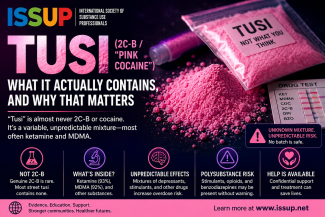
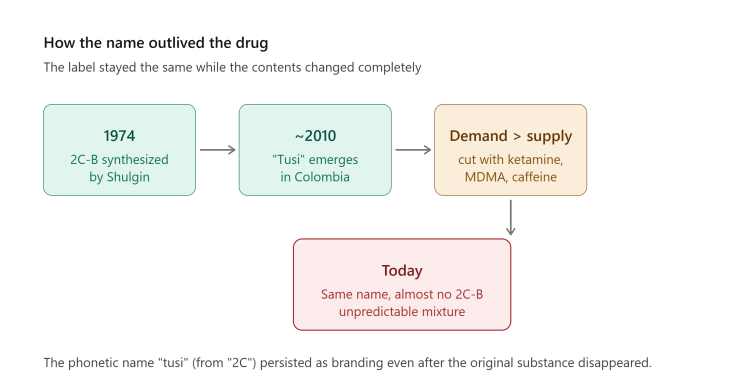
Few drugs are as widely misunderstood as the pink powder sold under the names "tusi," "tucibi," or "pink cocaine." It is also seen spelled "tuci" or "tussi," and pronounced "too-see." The confusion begins with the name itself. "Tusi" is a phonetic rendering of the Spanish pronunciation of "2C-B" — a psychedelic phenethylamine first synthesized by chemist Alexander Shulgin in 1974. The product first appeared in Colombia around 2010 and spread through nightlife scenes across Latin America, Spain, Australia, and the United States.
But here is the clinically important fact: the substance sold as "tusi" today almost never contains 2C-B. And despite the "pink cocaine" label, it usually contains little or no cocaine either. The name is a historical artifact that no longer describes what's in the bag.
This distinction is not academic. When someone believes they are taking a predictable psychedelic — or a stimulant like cocaine — but are actually consuming an unlabeled mixture of other drugs, the risk of a dangerous or fatal interaction rises sharply. Understanding what tusi actually is forms the foundation of any honest conversation about its dangers.
What 2C-B actually is
2C-B (4-bromo-2,5-dimethoxyphenethylamine) belongs to the "2C" family of psychedelic phenethylamines. It produces effects users have described as a blend of MDMA-like and LSD-like experiences, with both psychedelic and stimulant properties. Briefly marketed in the 1980s as a legal alternative to MDMA, it was placed in Schedule I in the United States in 1995. It remains a controlled substance with no accepted medical use.
Authentic 2C-B has a specific, identifiable pharmacological profile. The problem is that this profile has very little to do with the modern street product that borrows its name.
What "tusi" actually contains
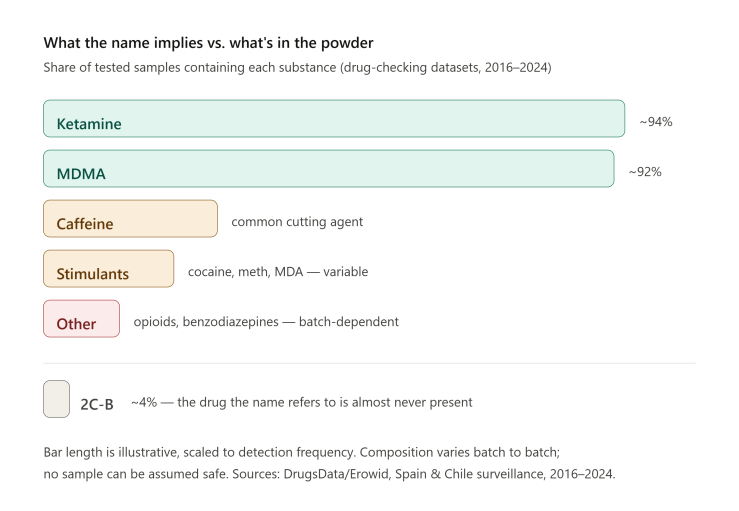
Multiple independent forensic and toxicology datasets now converge on the same conclusion: street tusi is a variable, unpredictable mixture in which ketamine and MDMA dominate, and genuine 2C-B is rare.
Multiple independent forensic and toxicology datasets now converge on the same conclusion: street tusi is a variable, unpredictable mixture in which ketamine and MDMA dominate, and genuine 2C-B is rare.
The most direct evidence comes from postmortem casework. A 2025 Miami-Dade Medical Examiner case series published in the Journal of Forensic Sciences examined fourteen powders connected to eight deaths. Ketamine was identified in every single submission, and most also contained MDMA. Investigators also found stimulants (cocaine, MDA, methamphetamine), an opioid (oxycodone), and a benzodiazepine (alprazolam) across the samples. None of the fourteen powders contained 2C-B.
Drug-checking programs show the same pattern at scale. An analysis of 68 samples submitted to Erowid's DrugsData program between 2016 and 2024 under the labels "pink cocaine," "tusi," or "2C-B" found that 94% contained ketamine and 81% contained MDMA. In a closer look at recent samples, ketamine made up roughly 40–90% of each, followed by MDMA at 10–45%.
The picture is consistent internationally. Among 470 tusi samples analyzed in Spain, ketamine appeared in 93.2% and MDMA in 92.1%, while 2C-B was detected in only 3.6%. In Chile, of 2,093 samples submitted as "2C" in a single year, 99% were ketamine-based and just 13 were actually 2C.
The reason traces back to simple economics. As demand for 2C-B outpaced supply, sellers bulked the powder with caffeine and the cheaper, more available ketamine and MDMA, until the product carried the name but almost none of the original substance.
Why the unpredictable composition is the central danger
The defining hazard of tusi is not any single ingredient — it's that the person using it cannot know what they are taking or in what amount. This creates several distinct risks.
Polysubstance interactions
A powder containing ketamine, MDMA, a stimulant, and sometimes an opioid or benzodiazepine combines depressant and stimulant effects in proportions that vary from one batch to the next. This unpredictability is precisely what makes dosing impossible to judge and overdose difficult to anticipate.
Mislabeling and mismatched expectations
Someone who believes "pink cocaine" is a stimulant may not anticipate the dissociative, sedating effects of a ketamine-dominant powder. Someone expecting the psychedelic profile of 2C-B may instead encounter a serotonergic load from high MDMA content. The mismatch between expectation and reality is itself a source of harm.
Contamination risk
Because composition is uncontrolled, the possibility of contamination with high-potency substances cannot be excluded, and the body's response to an unknown mixture cannot be predicted. The Miami-Dade series did not detect fentanyl in its samples, but other surveillance has flagged the broader danger of unlabeled powders, and the absence of any quality control means no batch can be assumed safe.
Why composition matters for treatment
For clinicians and for families seeking help, the variability of tusi has a direct practical consequence: you cannot effectively address what you cannot identify. A person who has been using "tusi" may have been exposed to ketamine, MDMA, stimulants, opioids, or benzodiazepines in combination — each of which carries different withdrawal considerations and different medical risks.
This is why a proper medical evaluation, rather than assumptions based on a street name, is the appropriate first step. Polysubstance exposure can complicate both acute care and longer-term recovery planning, and an accurate clinical picture depends on assessment by qualified professionals rather than on what the product was called. For people seeking to understand detox and medical evaluation options, navigation resources such as Every1Center can help connect individuals and families to appropriate care.
The way this drug is appearing in specific local markets is also worth understanding, since prevalence and overdose patterns differ by region. For a closer look at how pink cocaine is emerging in New York and the public-health response it calls for, see our companion overview.
Harm reduction and where to find help
The single most important harm-reduction message about tusi follows directly from the evidence: the name tells you nothing reliable about the contents. No assumption about effects, dose, or safety can be drawn from the labels "tusi," "tucibi," or "pink cocaine."
If you or someone you care about is struggling with substance use, confidential help is available. In the United States, the SAMHSA National Helpline (1-800-662-HELP) offers free, 24/7, confidential treatment referral and information. The 988 Suicide and Crisis Lifeline is available for anyone in immediate distress.
Frequently asked questions
Is tusi the same as cocaine?
No. Despite the street name "pink cocaine," forensic analyses consistently find that tusi usually contains little or no cocaine. It is most often a mixture dominated by ketamine and MDMA.
Does tusi contain 2C-B?
Rarely. Although "tusi" comes from the pronunciation of "2C-B," multiple drug-checking datasets find genuine 2C-B in only a small minority of samples — as low as 3.6% in one large analysis. Most street tusi contains no 2C-B at all.
What is actually in tusi?
Composition varies by batch, but ketamine and MDMA are the most common components, frequently alongside caffeine and sometimes stimulants, opioids, or benzodiazepines. The mixture is unpredictable.
Why is tusi considered dangerous?
The central danger is unknown composition. Because users cannot know which drugs or what amounts they are taking, the risk of unexpected interactions and overdose is significantly increased.
What should I do if someone has used tusi and seems unwell?
Seek emergency medical help immediately by calling 911. Because tusi may contain a combination of substances, an accurate medical evaluation is essential, and the street name should not be relied upon to describe what was taken.
References
Moore DM, Giachetti AD, Zaney ME, Potoukian RB, Hutchins KD. Tusi but not 2C: A Miami-Dade medical examiner case series highlighting the variable drug composition in colored powder paraphernalia. J Forensic Sci. 2025;70(3):1208–1216.
What Is Pink Cocaine? The Dark Reality behind a Colorful Name. J Med Chem. 2024.
An Update on the Epidemiology of Tusi ("Pink Cocaine"). PMC. 2025.
When pink powders shift the drug landscape: tusi ("pink cocaine") and other colored powders. Int J Drug Policy. 2025.