
Coke Nose: How Cocaine Damages the Nose and When It Becomes Irreversible
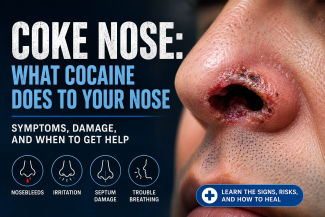
Quick Answer: "Coke nose" is the informal name for nasal damage caused by snorting cocaine. Because cocaine chokes off blood flow to the nasal lining, repeated use progresses from congestion, burning, and nosebleeds to septal perforation — a hole in the nose — and, in severe cases, collapse of the nasal bridge. Caught early, much of the damage is reversible.
Key Takeaways
- "Coke nose" and "cocaine nose" both describe cocaine-related nasal damage — from a runny, burning nose to permanent structural collapse.
- Cocaine is a vasoconstrictor: it starves nasal tissue of oxygen, which is why damage can escalate faster than users expect.
- Early signs — congestion, scabbing, nosebleeds — are usually reversible if snorting stops. A perforated septum or saddle nose usually is not.
- Repeated use can open a hole in the septum (septal perforation) and, in advanced cases, the roof of the mouth (palatal perforation).
- Most U.S. street cocaine is cut with levamisole, a veterinary dewormer that adds its own risk of tissue necrosis.
- The single biggest factor in whether the nose heals is whether cocaine use actually stops.
On This Page
- What Is Coke Nose?
- Why It Happens
- What It Looks Like
- Before and After
- The Four Stages
- Signs and Symptoms
- Early Warning Signs
- Runny Nose
- Cocaine Boogers
- Signs of Nose Damage
- Hole in the Nose
- Deviated Septum
- Saddle Nose
- Sinus Infections
- Palate Damage
- Can It Be Cured?
- Healing at Home
- Nose Spray
- Myths vs. Facts
- When to See a Doctor
- Treatment
- Cocaine Washout Syndrome
- Questions People Ask
What Is Coke Nose?
"Coke nose" is an informal term for the cluster of nasal and sinus injuries that develop from repeatedly snorting cocaine. It is not a single condition but a progression, beginning with irritation a person can easily mistake for a cold and ending, in severe cases, with permanent structural collapse of the nose.
The reason the nose is so vulnerable comes down to how cocaine behaves in the body. The tissue lining the nasal passages and the cartilage of the septum depend on a steady blood supply to stay alive, moist, and able to repair small injuries. Cocaine is a potent vasoconstrictor, meaning it clamps down on blood vessels. Each time the drug is snorted, it starves the nasal lining of oxygen. Repeated often enough, this turns minor wear into wounds that no longer heal.
Why Cocaine Damages the Nose
Several mechanisms compound one another, which is why cocaine's effects on the nose can escalate faster than people expect, and why even a burning sensation after snorting is an early warning rather than a harmless side effect.
Restricted blood flow. The vasoconstriction that gives cocaine part of its effect also cuts oxygen delivery to the septum and surrounding cartilage. Cartilage already has a poor blood supply, so it is among the first structures to suffer when circulation is repeatedly choked off.
Drying and mechanical irritation. Snorting dries the mucous membranes and physically abrades them. This is why cocaine burns the nose and leaves it raw: dry, cracked tissue scabs, bleeds, and reopens, so small wounds rarely get the chance to close.
Tissue death. When oxygen deprivation is chronic, sections of the lining and cartilage begin to die, a process called necrosis. This is the turning point where reversible irritation becomes permanent loss.
Adulterants. Street cocaine is rarely pure. Cutting agents and contaminants — including levamisole, phenacetin, lidocaine, benzocaine, caffeine, xylazine, and increasingly fentanyl — add their own irritant and toxic burden to already fragile tissue.
The levamisole problem. By 2009, U.S. Drug Enforcement Administration testing found roughly 70% of seized cocaine was cut with levamisole, a veterinary deworming agent withdrawn from human medicine in 2000. Levamisole is independently linked to tissue necrosis, ANCA-positive vasculitis, and dangerous drops in white blood cells (agranulocytosis) — so the nose is being assaulted by both the cocaine and its most common adulterant at once. Because adulterants are chosen partly for resembling cocaine, no amount of visual inspection identifies them; see What Is Fishscale Cocaine? Purity, Adulterants and Risk.
What Does Coke Nose Look Like?
What coke nose looks like depends entirely on how far the damage has progressed — the "before and after" is really a spectrum, not two snapshots.
- Early: the nose looks mostly normal from the outside, but the inside is red, raw, and scabbed, with visible crusting around the nostrils and dried blood.
- Moderate: ulcers and dark or dead-looking tissue appear inside the nostrils; there may be a persistent foul smell and near-constant crusting.
- Advanced: a visible hole appears in the wall between the nostrils (septal perforation), sometimes producing a whistling sound on breathing.
- Severe: the external shape of the nose changes — the bridge flattens, widens, or sinks (saddle nose deformity), which is the most recognizable "after" appearance of long-term use.
Because the earliest and most treatable stage is largely invisible from the outside, people often do not realize what coke nose looks like until structural damage has already begun.
Coke Nose Before and After
People searching for coke nose before-and-after images are usually trying to answer one of two questions: whether their own nose has changed, or whether someone they care about is using. Both deserve a straight answer.
The most important thing to understand is that the meaningful "before and after" is almost entirely internal, and it happens long before anything is visible from the outside. By the time the shape of the nose has changed, cartilage has already been destroyed and the change is permanent. The externally visible stage is the end of the progression, not a warning at the start of it.
There is also a second before-and-after worth knowing about, and it is the more hopeful one. Early-stage damage — irritation, crusting, bleeding, recurrent congestion — frequently improves substantially once snorting stops and the tissue is allowed to heal. People are often surprised by how much recovers in the first few months of abstinence. That version of before-and-after is the one still available to most people who are searching for this.
The Stages of Coke Nose
Nasal damage tends to follow a predictable progression. The earlier it is caught, the more of it can be reversed.
| Stage | What's happening | Typical signs | Reversible? |
|---|---|---|---|
| Early irritation | Lining dries and inflames; blood flow repeatedly restricted | Stuffiness, runny nose, burning, scabbing, occasional nosebleeds | Often, if use stops |
| Nasal necrosis (tissue death) | Chronic oxygen loss kills sections of lining and cartilage | Ulcers, foul smell, dark or dead-looking tissue, heavy nosebleeds | Partially; some loss is permanent |
| Septal perforation | The wall between the nostrils breaks down, forming a hole | Whistling on breathing, crusting, visible hole, recurring infection | Rarely on its own; usually needs treatment |
| Nasal collapse (saddle nose) | Supporting cartilage is destroyed; the bridge loses structure | Flattened or sunken bridge, change in nose shape, blocked breathing | No; requires reconstructive surgery |
Signs and Symptoms of Coke Nose
The full symptom picture is broader than most people expect, and two of the most telling signs are ones users rarely connect to cocaine at all.
- Nosebleeds. Frequent bleeding from fragile, oxygen-starved nasal lining.
- Crusting and scabbing. Hard scabs and chronic congestion inside the nostrils.
- Loss of smell. Reduced or absent ability to smell, which also flattens the taste of food. Damage to the olfactory tissue high in the nasal cavity accumulates quietly and is often the first permanent loss a person notices.
- Septal perforation. A growing hole in the cartilage wall separating the nostrils.
- Saddle nose. Flattening or collapse of the outer nasal bridge from loss of internal support.
- Noisy or difficult breathing. Whistling, snoring, or obstructed airflow as the internal architecture changes.
- Sleep apnea. Structural narrowing and chronic congestion can disrupt breathing during sleep.
- Nasal necrosis. Dark, grey, or dead-looking tissue inside the nostril — a medical emergency rather than a symptom to monitor.
Clinical note on anosmia: Loss of smell is under-reported because it arrives gradually and because people attribute it to allergies or age. Ask about it directly — the answer is often yes, and it frequently predates any structural finding on examination. Partial recovery is possible if use stops early; established anosmia usually is not reversible.
Early Warning Signs
The first stage is easy to wave off as allergies or a lingering cold. The tell is that the symptoms cluster around cocaine use and keep returning.
- Persistent stuffiness or a runny nose
- Burning, stinging, or dryness inside the nostrils
- Painful scabs and crusting
- Frequent nosebleeds
- Post-nasal drip — the constant back-of-throat drainage often called "coke drip" — and recurring sinus pressure
- A bad smell inside the nose, or pain concentrated in one nostril
This is the stage where stopping use and getting an evaluation can still prevent lasting harm. People who recognize a problem at this point have the best odds of avoiding surgery later. If a hole has already begun to form, see our guide on How to Heal Hole in Nose from Cocaine Addiction.
Does Cocaine Make Your Nose Run?
Yes, and the pattern is characteristic enough to be a recognition sign. Cocaine constricts the blood vessels in the nasal lining; as the drug wears off, those vessels rebound and dilate, producing congestion and a persistent runny nose. The result is a cycle of a blocked or dripping nose that tracks with use and never quite clears.
Chronic irritation also drives the lining to overproduce mucus in an attempt to protect itself. This is why a constantly running or stuffy nose — often mistaken for allergies that never respond to allergy treatment — is one of the earliest and most commonly missed indicators of regular snorting.
Cocaine Boogers and Nasal Crusting
"Cocaine boogers" is the common term for the persistent crusts and discolored mucus that build up inside the nose with regular use. They form because cocaine dries out the nasal lining and cuts off its blood supply, so mucus mixes with dried blood, dead cells, and leftover drug residue and hardens into stubborn crusts rather than clearing normally.
The color is a useful warning sign. Bloody or rust-colored crusts point to fragile, bleeding tissue. Black, gray, or dark green boogers are more concerning: they can signal necrotic (dead) tissue or infection, and are a reason to stop use and see a clinician promptly. Constant crusting, along with a foul smell, is also one of the earliest signals that damage is progressing toward ulceration and, eventually, a septal perforation.
Signs of Nose Damage From Drugs
As injury accumulates, the signs of cocaine nose damage become harder to dismiss and harder to reverse.
- A whistling sound when breathing
- A visible opening between the nostrils
- Heavy, repeated nosebleeds
- Chronic sinus infections and foul-smelling drainage
- Black, gray, or dead-looking tissue
- Changes in the shape of the nose, including flattening or sinking of the bridge
These point toward septal perforation, deep infection, cartilage loss, or early collapse. Fever, facial swelling, severe pain, or dark tissue warrant urgent medical attention rather than watchful waiting.
Septal Perforation: A Hole in the Nose
Repeated cocaine use can open a hole in the nasal septum, the wall of cartilage and tissue dividing the nostrils. This hole in the nose is called a septal perforation. It develops when the drug repeatedly cuts blood flow to the septum until the tissue ulcerates and the wall breaks down.
Signs of a perforated septum from drug use include whistling on breathing, crusting around the septum, recurrent nosebleeds, pressure or pain inside the nose, a visible hole, and recurring infection. A true perforation generally will not close while cocaine use continues, and many do not close on their own even after use stops. For more on this, read about how to fix a hole in the nose from cocaine.
Can Cocaine Cause a Deviated Septum?
Not exactly — and the distinction matters. A deviated septum means the wall between the nostrils is bent or off-center, and it is usually congenital or caused by trauma. What cocaine does is different and generally more serious: it destroys and perforates the septum rather than simply displacing it. People often search for "cocaine deviated septum," but the accurate term for cocaine-related damage is a septal perforation — a hole — or, in advanced cases, collapse of the septal support. Either way, cocaine-related structural damage typically requires ENT evaluation rather than the routine septoplasty used for a true deviated septum.
Nasal Collapse and Saddle Nose
In the most severe cases, the cartilage supporting the bridge is destroyed and the nose loses its internal scaffolding. The bridge can flatten, widen, or sink inward — a change known as saddle nose deformity, sometimes searched as "nose collapse from coke" or "saddle nose from drugs." Once the structural support is gone, the nose cannot rebuild it, and correction requires evaluation by an ENT surgeon or reconstructive specialist.
Cocaine and Sinus Infections
Chronic cocaine use damages the lining that normally clears mucus and traps pathogens, and it blocks normal sinus drainage. The result is recurrent, hard-to-treat sinus infections — one of the most common reasons long-term users first see a doctor. Signs include facial pressure, thick or foul-smelling discharge, congestion that never fully clears, and repeated courses of antibiotics that only briefly help. Because the underlying cause is ongoing tissue damage, sinus infections tend to keep returning until cocaine use stops.
When Damage Spreads: Palatal Perforation and CIMDL
In advanced, long-term use, the destruction can extend beyond the nose into the roof of the mouth, sinuses, and even the eye socket. Clinicians call this pattern cocaine-induced midline destructive lesions (CIMDL), estimated to affect roughly 5% of chronic cocaine users. When it reaches the palate, it can create a palatal perforation — a hole in the roof of the mouth — leading to food and liquid passing into the nose (oro-nasal reflux) and a nasal, hard-to-understand quality of speech.
Clinical Pearl: CIMDL closely mimics ANCA-associated vasculitis such as granulomatosis with polyangiitis (formerly Wegener's), and patients often test positive for ANCA. Clinicians who do not take a candid substance-use history can misdiagnose destructive midface lesions as autoimmune disease and treat them with immunosuppression. A cocaine history — and testing for antibodies against human neutrophil elastase — is what distinguishes CIMDL from true vasculitis.
Can Coke Nose Be Cured?
The honest answer depends on how far the damage has gone. Mild irritation, dryness, and minor bleeding often improve once snorting stops and the tissue is protected. A septal hole, lost cartilage, or a collapsed bridge usually does not heal on its own and is not something home remedies can cure.
Outcomes hinge on how long and how often cocaine was used, whether infection is present, whether the septum is already perforated, how much cartilage has been lost, and, above all, whether use has actually stopped. Continued use is the single biggest obstacle to healing and the most reliable way to make damage worse.
How to Heal Coke Nose at Home
The decisive step is stopping the snorting. Nothing applied to the nose compensates for continued use, and anything that promises otherwise is selling something.
Beyond that, gentle measures genuinely help the tissue recover: sterile saline spray, a humidifier, staying hydrated, avoiding nose-picking and harsh rinses, and getting medical care for pain, bleeding, infection, or breathing trouble.
Equally important is what not to do. Peroxide, alcohol, unknown creams, crushed pills, and harsh products do not belong inside the nose; they irritate fragile tissue and can deepen the injury. If there is infection, open tissue, a hole, or blackened tissue, self-treatment is not enough.
Is There a Nose Spray for Coke Nose?
Sterile saline spray is the one that helps, and it is available in any pharmacy. It moisturises the lining, softens crusts so they clear without tearing tissue, and supports the mucosa's own repair. It can be used several times a day without harm.
What to avoid matters more. Decongestant sprays such as oxymetazoline are vasoconstrictors — the same mechanism that caused the damage in the first place. Using them on an already oxygen-starved lining works against healing and can produce rebound congestion that keeps the cycle going. Medicated or antibiotic ointments should only be used if a clinician has examined the nose and recommended them.
No spray closes a perforation or rebuilds cartilage. Where structural damage exists, saline is comfort care while the actual treatment is decided.
Myths vs. Facts
| Myth | Fact |
|---|---|
| If my nose still looks normal, there's no damage. | The treatable stage is entirely internal. Visible change means cartilage is already gone. |
| Switching nostrils prevents damage. | Both sides share one septum, and the vasoconstriction is systemic to the nasal lining. |
| A saline rinse can heal a hole in the septum. | Saline supports tissue comfort. A perforation needs ENT evaluation and often surgery. |
| Purer cocaine is gentler on the nose. | Purity is unverifiable, and the vasoconstriction that destroys tissue is caused by the cocaine itself. |
| It doesn't hurt, so it isn't serious. | Cocaine is a local anaesthetic. It numbs the damage it is causing. |
| Damage stops when you stop. | Progression stops. Existing structural loss does not reverse, and infection can continue. |
When to See a Doctor
Seek care if you notice a hole in the septum, repeated nosebleeds, severe pain, fever, facial swelling, green or foul-smelling discharge, black or gray tissue, difficulty breathing, whistling on breathing, or a collapsing bridge. These can signal infection, tissue death, perforation, or structural collapse, none of which improve by waiting.
Treatment for Coke Nose
A clinician will examine the inside of the nose for infection, ulceration, perforation, and cartilage loss, then match treatment to severity. That may mean stopping cocaine use, clinician-recommended saline care, treating any infection, moisturizing strategies for dry tissue, ENT evaluation for perforation, a septal button in some cases, and reconstructive surgery for severe structural damage. Surgery is usually deferred until use has stopped and the tissue has stabilized, since active use sharply raises the risk of surgical failure.
For people whose nasal damage stems from ongoing cocaine use, the most durable fix is treating the addiction itself, since the nasal injury is downstream of the substance use. Understanding why cocaine is so hard to quit is often the first step, and people on Long Island seeking structured care can find vetted programs through Cocaine Addiction Treatment on Long Island.
What Is Cocaine Washout Syndrome?
Cocaine Washout Syndrome (CWS) is a rare state of profound central nervous system depression — extreme lethargy, or even a coma-like state — that can follow an extended cocaine binge. It is best understood as a severe form of the post-binge "crash": the brain's overtaxed reward and arousal systems become so depleted that a person may be difficult to rouse. CWS typically resolves over hours to a few days with rest and supportive medical care, but it can be alarming and warrants evaluation to rule out other causes.
Frequently Asked Questions
What does cocaine do to your nose?
Cocaine is a vasoconstrictor, so it clamps down on the blood vessels in the nasal lining and starves the tissue of oxygen. With repeated use, the lining dries, scabs, and bleeds, then ulcerates. Over time this can destroy the cartilage, perforate the septum, and collapse the nasal bridge.
What does coke nose look like?
Early on the nose looks normal outside but is red, raw, and scabbed inside. As damage advances, ulcers and dead-looking tissue appear, then a visible hole in the septum, and in severe cases the bridge flattens or sinks (saddle nose).
Does cocaine burn your nose?
Yes. Street cocaine is often acidic and mixed with harsh cutting agents like levamisole, and its crystals physically abrade the nasal lining while the drug constricts blood vessels and starves the tissue. The result is a burning, stinging sensation — an early sign of real tissue damage, partly masked by cocaine's anesthetic effect.
Does cocaine make your nose run?
Yes. Cocaine constricts nasal blood vessels, and when it wears off those vessels rebound and dilate, causing congestion and a persistent runny nose. Chronic irritation also drives excess mucus production, which is why a runny or blocked nose that never quite clears is one of the earliest signs of regular use.
What are cocaine boogers, and why are they black?
Cocaine boogers are the hard crusts that form when cocaine dries the nasal lining and mucus mixes with dried blood, dead cells, and drug residue. Bloody crusts signal fragile tissue; black, gray, or dark-green boogers can indicate dead tissue or infection and warrant prompt medical evaluation.
Why does cocaine cause nosebleeds?
Cocaine is a powerful vasoconstrictor, so snorting it sharply narrows the blood vessels in the nasal lining and cuts off oxygen. The starved tissue dries out, weakens, and cracks, leaving fragile blood vessels that rupture and bleed easily — often the first visible sign of nasal damage. For a full breakdown, see our guide on why cocaine causes nosebleeds.
Does cocaine make you lose your sense of smell?
Yes. Repeated vasoconstriction damages the olfactory tissue high in the nasal cavity, reducing or eliminating the sense of smell and flattening the taste of food. It develops gradually and is commonly mistaken for allergies. Stopping early offers the best chance of partial recovery; long-established loss is usually permanent.
What is nasal necrosis from cocaine?
Nasal necrosis is the death of tissue inside the nose from chronic oxygen deprivation. It appears as black, grey, or dead-looking tissue, often with a foul smell, and is the stage at which reversible irritation becomes permanent loss. It warrants urgent medical attention, not watchful waiting.
Can coke nose be cured or healed?
Mild irritation can heal after stopping use. Structural damage such as a septal hole or collapsed bridge usually cannot be cured at home and requires medical or surgical treatment. Healing depends most on whether cocaine use stops.
What nose spray helps coke nose?
Sterile saline spray is the appropriate choice — it moisturises the lining and softens crusts without further harm. Avoid decongestant sprays such as oxymetazoline, which constrict blood vessels through the same mechanism that caused the damage. No spray repairs a perforation.
Can cocaine cause a hole in your nose?
Yes. By repeatedly cutting off blood flow to the septum, cocaine starves the cartilage of oxygen until the tissue ulcerates and dies. Because cocaine also numbs the area, the damage is often painless until a hole — a septal perforation — has formed in the wall between the nostrils.
Can cocaine cause a deviated septum?
Cocaine typically causes a septal perforation (a hole) or collapse rather than a true deviated septum, which is usually congenital or from trauma. The damage is structural destruction, not simple displacement.
Can cocaine cause a hole in the roof of your mouth?
In advanced, long-term use, yes. The same tissue-starving process that perforates the septum can erode downward through the hard palate, creating a hole — an oro-nasal fistula — between the mouth and nasal cavity. This causes food and liquid to leak into the nose and a nasal quality of speech, part of a pattern clinicians call CIMDL.
Can cocaine change the shape of your nose?
Yes. When cocaine destroys the cartilage that supports the nasal bridge, the bridge loses its internal scaffolding and can flatten, widen, or sink inward — a change called saddle nose deformity. Because the structural support is gone, the nose cannot rebuild it, and correction requires reconstructive surgery.
How is coke nose treated?
The first step is stopping use. Treatment may add saline care, humidification, infection treatment, ENT evaluation, a septal button, and reconstructive surgery in severe cases.
Related Guides
- What Is Fishscale Cocaine? Purity, Adulterants and Risk — why appearance cannot tell you what is in a powder, and what levamisole does.
- Why Does Cocaine Cause Nosebleeds? — causes, warning signs, and when bleeding signals deeper damage.
- Can Cocaine Cause a Hole in Your Nose? Long-Term Nasal Damage and Clinical Treatment Strategies — clinical evaluation and treatment of septal perforation.
- Is Cocaine the Hardest Drug to Quit? Withdrawal & Recovery — why cocaine dependence is so difficult to overcome.
- How Long Does Cocaine Stay in Your System? Test Windows — detection windows by test type.
- Cocaine and Alcohol: Cocaethylene and Cardiac Risk — what happens when the two are combined.
- 5 Most Addictive Drugs of Abuse in 2026: Evidence-Based Rankings — where cocaine ranks.
References
- National Institute on Drug Abuse. Cocaine Research Topics. NIDA, NIH. https://nida.nih.gov/research-topics/cocaine
- Trimarchi M, Bertazzoni G, Bussi M. Cocaine-induced midline destructive lesions. Rhinology. PubMed PMID 24932619. https://pubmed.ncbi.nlm.nih.gov/24932619/
- Distribution of cocaine-induced midline destructive lesions: systematic review and classification. PMC. https://pmc.ncbi.nlm.nih.gov/articles/PMC9130192/
- Cocaine-induced midline destructive lesions: a challenge in oral rehabilitation (palatal perforation). PMC. https://www.ncbi.nlm.nih.gov/pmc/articles/PMC8003646/
- Levamisole-adulterated cocaine-associated ANCA vasculitis: review and pathogenesis (DEA Cocaine Signature Program data). PMC. https://pmc.ncbi.nlm.nih.gov/articles/PMC6292360/
- Complications associated with use of levamisole-contaminated cocaine: an emerging public health challenge. PMC. https://pmc.ncbi.nlm.nih.gov/articles/PMC3498128/
- MedlinePlus. Cocaine. U.S. National Library of Medicine. https://medlineplus.gov/cocaine.html
About the Author
Benjamin Zohar, NCACIP, is a Nationally Certified Advanced Clinical Intervention Professional and ISSUP network moderator specializing in addiction intervention, treatment navigation and emerging substance-use risks.
He publishes evidence-informed resources addressing counterfeit medications, fentanyl exposure, benzodiazepine safety, kratom dependence and concentrated 7-hydroxymitragynine products. His work published through ISSUP has been cited or referenced by GoodRx, The Washington Post, WIRED and Newsweek.
Written by: Benjamin Zohar, NCACIP
Medical Review
Medically reviewed by: Brandon McNally, RN
Medical Disclaimer
This article is intended for educational and public-health purposes. It does not provide individualized medical advice, diagnosis or a tapering schedule. Do not start, stop or alter a prescription medication without consulting a qualified healthcare professional. Call emergency services for seizures, difficulty breathing, loss of consciousness, severe confusion or other life-threatening symptoms.