
Recovery Definition: Meaning in Addiction Treatment
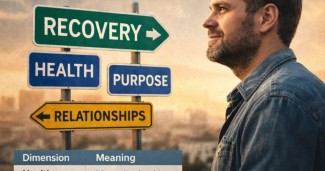
By Benjamin Zohar, NCACIP — ISSUP New York Network Moderator
ISSUP Addiction Glossary: Abstinence | Recovery | Relapse | Drug-Free | Just Say No | The J-Word | Harm Reduction | Self-Medicating | Polysubstance Use | Full Glossary
Key Takeaway
Recovery is a process of change through which individuals improve their health and wellness, live a self-directed life, and strive to reach their full potential. In addiction treatment, recovery encompasses far more than abstinence — it includes physical health, mental health, relationships, housing, purpose, and community.
| SAMHSA Dimension | What It Means | Example |
|---|---|---|
| Health | Overcoming or managing disease; healthy choices | Treating co-occurring mental health conditions |
| Home | Stable, safe place to live | Recovery housing, sober living environments |
| Purpose | Meaningful daily activities and independence | Employment, education, volunteering |
| Community | Supportive relationships and social networks | Recovery groups, family, peer support |
Understanding what relapse means is essential context, because recovery is not linear — and knowing how to respond when setbacks occur is part of the recovery process itself.
Recovery is perhaps the most important word in the substance use field — and one of the most difficult to define. It means different things to different people, different things in different clinical contexts, and different things at different stages of a person's journey. But getting the definition right matters, because how we define recovery shapes how we design treatment systems, how we measure success, and how individuals and families understand what they are working toward.
What Is Recovery? The Official Definition
In 2012, the Substance Abuse and Mental Health Services Administration (SAMHSA) established a working definition of recovery that has become the most widely cited in the field:
"A process of change through which individuals improve their health and wellness, live a self-directed life, and strive to reach their full potential."
This definition is notable for what it includes — and what it does not. It frames recovery as a process, not an endpoint. It emphasizes health, self-direction, and potential — not just the absence of substance use. And it does not require abstinence as a defining condition, though abstinence may be a component of recovery for many individuals.
The Four Dimensions of Recovery
SAMHSA identifies four major dimensions that support a life in recovery:
1. Health
Overcoming or managing one's disease(s) or symptoms, and making informed, healthy choices that support physical and emotional well-being. This includes addressing co-occurring mental health conditions, maintaining physical health, and managing the ongoing effects of substance use disorder.
2. Home
Having a stable and safe place to live. Housing instability is one of the strongest predictors of relapse, and access to safe housing is foundational to sustained recovery. Recovery housing, sober living environments, and drug-free residences all serve this dimension.
3. Purpose
Conducting meaningful daily activities — such as a job, school, volunteering, or creative pursuits — and having the independence, income, and resources to participate in society. Purpose provides structure, identity, and motivation that sustain recovery over time.
4. Community
Having relationships and social networks that provide support, friendship, love, and hope. Recovery does not happen in isolation. The quality of a person's social connections — including recovery support groups, family relationships, and community involvement — is one of the strongest predictors of long-term recovery success.
Recovery vs. Abstinence vs. Sobriety
These three terms are often used interchangeably, but they describe different things:
- Abstinence is a behavior — the absence of substance use
- Sobriety is often used colloquially to mean abstinence, but in recovery communities it implies a broader commitment to a substance-free way of living
- Recovery is a comprehensive process of healing that may include abstinence but also encompasses physical health, mental health, relationships, housing, purpose, and community
A person can be abstinent without being in recovery. This sometimes manifests as what 12-step communities call a "dry drunk" — someone who has stopped using substances but has not addressed the underlying conditions, behaviors, and patterns that drove their use. They are abstinent, but they are not well.
Conversely, some definitions of recovery do not require complete abstinence. Individuals who have resolved their substance use problems through moderation, harm reduction, or medication-assisted treatment may consider themselves in recovery even if they are not fully abstinent from all substances. This remains one of the most actively debated questions in the field.
Recovery Capital: The Resources That Sustain Recovery
One of the most important concepts in modern recovery science is recovery capital — the sum of internal and external resources that a person can draw upon to initiate and sustain recovery. The concept was developed by researchers William Cloud and Robert Granfield and has become central to how professionals understand why some people sustain recovery and others struggle.
Recovery capital includes four types of resources:
- Social capital — supportive relationships, recovery community connections, family involvement, peer support
- Physical capital — health, housing stability, financial resources, transportation, safe environment
- Human capital — education, job skills, knowledge, problem-solving ability, self-efficacy
- Cultural capital — values, beliefs, cultural identity, and traditions that support recovery
The recovery capital framework shifts the focus from "what's wrong with this person" to "what resources does this person need to sustain recovery." This is the approach taken by treatment navigation and intervention services — connecting individuals and families not just to treatment, but to the full range of resources that make sustained recovery possible.
The Recovery Process: What to Expect
Recovery is not linear. It typically involves multiple phases, and the experience varies significantly based on the individual, the substance(s) involved, the severity of the disorder, and the resources available.
Early Recovery (0-12 months)
The most vulnerable period. Physical stabilization, acute treatment, and the initial adjustment to life without substances. Cravings are typically strongest during this phase. Support needs are highest. This is the phase where professional intervention and rapid access to appropriate treatment can be most impactful.
Sustained Recovery (1-5 years)
The person is building a new life in recovery. Relationships are being rebuilt, employment or education is being pursued, coping skills are deepening, and identity is shifting from "person in treatment" to "person in recovery." Relapse risk decreases but remains present, particularly during major life stressors.
Long-Term Recovery (5+ years)
Recovery becomes more integrated into daily life. The person has typically developed a stable support network, a sense of purpose, and effective coping strategies. Research from NIDA shows that relapse risk drops to approximately 14% after 5 years of sustained recovery. However, recovery capital still needs to be maintained — long-term recovery is not autopilot.
SAMHSA's Guiding Principles of Recovery
In addition to the four dimensions, SAMHSA identified 10 guiding principles of recovery:
- Recovery emerges from hope
- Recovery is person-driven
- Recovery occurs via many pathways
- Recovery is holistic
- Recovery is supported by peers and allies
- Recovery is supported through relationships and social networks
- Recovery is culturally-based and influenced
- Recovery is supported by addressing trauma
- Recovery involves individual, family, and community strengths and responsibility
- Recovery is based on respect
Principle 3 — "recovery occurs via many pathways" — is particularly significant. It acknowledges that there is no single right way to recover, and that the path to recovery is as individual as the person walking it.
Frequently Asked Questions About Recovery
What is recovery?
Recovery is a process of change through which individuals improve their health and wellness, live a self-directed life, and strive to reach their full potential. It encompasses far more than stopping substance use — it includes physical health, mental health, relationships, housing, purpose, and community.
Is recovery the same as being sober?
No. Sobriety typically refers to abstinence from substances. Recovery is a broader process that includes rebuilding one's life, addressing underlying conditions, and developing the resources and relationships needed for sustained well-being.
How long does recovery take?
Recovery is a lifelong process. The acute phase may last months to years, but the broader process of growth, maintenance, and well-being continues indefinitely.
What is recovery capital?
Recovery capital refers to the internal and external resources — social connections, housing, health, education, employment, cultural identity — that a person draws upon to sustain recovery.
Can someone be in recovery and still take medication?
Yes. SAMHSA, NIDA, ASAM, and the WHO all recognize medication-assisted treatment (buprenorphine, methadone, naltrexone) as a legitimate component of recovery. Taking prescribed medication for a substance use disorder is no different from taking prescribed medication for any other chronic condition.
Why Understanding Recovery Matters
How we define recovery shapes how we design treatment systems, how we measure success, how insurance companies determine coverage, and how individuals and families understand what they are working toward. A narrow definition that equates recovery with abstinence alone excludes people on medication-assisted treatment, people using harm reduction strategies, and people who are making meaningful progress but have not achieved complete cessation. SAMHSA's broader definition — emphasizing health, home, purpose, and community — creates space for the diversity of recovery pathways that research supports.
Expert Insight
Recovery scientists increasingly emphasize recovery capital — the sum of resources a person can draw upon — as a better predictor of long-term outcomes than any single measure like abstinence duration. A person with strong social connections, stable housing, meaningful employment, and good mental health care has significantly better long-term prospects than someone who is abstinent but isolated, unemployed, and untreated for co-occurring conditions. This is why treatment navigation services focus on connecting people to the full range of resources that sustain recovery, not just to treatment alone.
Definition Recap
Recovery is a process of change through which individuals improve their health and wellness, live a self-directed life, and strive to reach their full potential (SAMHSA, 2012). Recovery is supported by four dimensions — health, home, purpose, and community — and is guided by 10 principles including hope, person-driven pathways, and respect. Recovery is not the same as sobriety or abstinence; it is a broader, lifelong process of healing and growth.
Citations
SAMHSA (2012). SAMHSA's Working Definition of Recovery: 10 Guiding Principles of Recovery.
Cloud, W. & Granfield, R. (2008). Conceptualizing Recovery Capital: Expansion of a Theoretical Construct. Substance Use & Misuse, 43(12-13), 1971-1986.
Kelly, J.F. & Hoeppner, B. (2015). A biaxial formulation of the recovery construct. Addiction Research & Theory, 23(1), 5-9.
White, W.L. (2007). Addiction recovery: Its definition and conceptual boundaries. Journal of Substance Abuse Treatment, 33(3), 229-241.
Betty Ford Institute Consensus Panel (2007). What is recovery? A working definition from the Betty Ford Institute. Journal of Substance Abuse Treatment, 33(3), 221-228.
Related Addiction Glossary Terms
- Abstinence: definition and how it relates to recovery — why abstinence and recovery are not the same thing
- Relapse in the context of recovery — the three stages, why 40-60% of people experience it, and why it doesn't erase progress
- What does drug-free mean vs. being in recovery? — the distinction between behavioral abstinence and holistic recovery
- The failure of "Just Say No" and what recovery science teaches us instead — why evidence-based recovery support replaced slogans
- Person-first language in recovery — why saying "person in recovery" instead of "recovering addict" changes outcomes
- Harm reduction — a recovery-compatible approach that meets people where they are
- Rat Park — the experiment that changed how we think about addiction, connection, and recovery
About the author: Benjamin Zohar is a Nationally Certified Advanced Clinical Intervention Professional (NCACIP) and the ISSUP New York Network Moderator. He operates Every1 Center (Google Maps) and treatment navigation services including Hudson Valley Addiction Treatment Center (Google Maps), Long Island Addiction Treatment Resources (Google Maps), and Intervention NY.