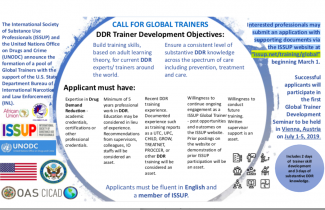
Zili Sloboda, Sci.D, President of Applied Prevention Science International presents Prevention Science and Its Application to Substance Use Prevention Interventions and Policy: The Role of Universities.
Since the 1930s, the response to drug addiction has moved from one that focuses on the need to punish users to another that recognises the importance of prevention and treatment approaches.
In other words, thanks to scientific advances, substance abuse has evolved from a judicial to a heath issue.
Drawing on the latest evidence-based knowledge, Drugs, Brains and Behavior: The Science of Addiction, a new publication from the National Institute on Drug Abuse (NIDA), looks to explain why people become dependent on drugs, as well as how changes in the brain can foster drug addiction.
UNODCs online eLearning courses deliver trainings to a community of over 50,000 Member State officials on international security threats such as transnational organized crime, terrorism, illicit drugs, trafficking in persons and smuggling of migrants, wildlife and forest crime, cybercrime as well as provide training on border control, intelligence analysis, gender issues, anticorruption, HIV/AIDS and human rights.
These courses, developed by leading international experts, enable law enforcement officers and other professionals to expand their knowledge and stay up to date with the...
Angelina Brotherhood shares the preliminary results on peoples understanding of spaces in their everyday life, and how those ways of thinking relate to their substance use.
Drug and Alcohol Findings have announced the top five studies in the field of drug education.
The five studies describe drug prevention curriculum and techniques that have been tried and tested, with varying degrees of success, in Western countries. The authors of the five studies analyse the evidence base and highlight discrepancies in the research. The pros and cons of the different programmes are discussed and the authors of the five studies go on to make recommendations as to whether the different forms of drug prevention curriculum could be successfully implemented within the British...
Elkbuli et al. Substance AbuseTreatment, Prevention, and Policy (2019) 14:1 https://doi.org/10.1186/s13011-018-0189-7
Abstract
Background
Behavioral Interventions are needed to prevent HIV in substance users, which is associated with higher risk for contracting HIV via unprotected sexual intercourse or syringe-based exposure. We reviewed universal HIV prevention interventions targeting intravenous drug users (IDUs) and non-IDUs (NIDUs) to identify which prevention interventions are the most effective at reducing HIV transmission risk among IDU’s and NIDU’s and identify gaps in the literature.
Methods
A PubMed literature review (1998–2017), limiting studies to universal HIV prevention interventions...
SAMHSA hosted a webinar on ways local organizations such as coalitions, law enforcement, health departments, and other community groups can collaborate with schools to implement the “Talk. They Hear You.”® parent-focused national media campaign.
UNODC Scientific Consultation – December 2015 EARLY IS BETTER: PREVENTION IN EARLY CHILDHOOD CAN REDUCE DRUGS AND CRIME LATER Sheppard G. Kellam Professor Emeritus Johns Hopkins Bloomberg School of Public Health An important early risk factor for later illicit drug abuse and crime is failure to...
Нашақорлық туралы ғылым күрделене түседі де, анықтамалар, үлгілер, теориялар бойынша пікірталастар жалғаса беретін өріс болып қала береді .
EMCDDA Insight Review нашақорлықтың әр түрлі модельдерін сыни талдауды қамтамасыз етеді.
Зерттеушілер алдын алу, бағалау және емдеу практикасын басшылыққа алу үшін пайдаланылуы мүмкін жиналған құрылымға әр түрлі модельдерді орналастыру жолдарын зерттейді.
Авторлар баяндама оқырманға нашақорлыққа қатысты күрделі мәселелерді түсінуді дамытуда қолдау көрсетіп, сұрақтарды шабыттандырып, пікірталас ашады деп үміттіледі.
It reflects “a growing body of research […] showing that providing a stable home environment, adequate nutrition, physical and cognitive stimulation, warm supportive parenting, and good classroom management in the early years of a child’s life (prenatal through age 8) can lead the child to develop strong self-regulation”.
The publication touches on topics such as prevention science, policy, interventions targeting different stages of childhood development including prevention during pregnancy and within families, school based programmes, and prevention in...
Venniro, M., Zhang, M., Caprioli, D., Hoots, J. K., Golden, S. A., Heins, C., ... & Shaham, Y. (2018). Volitional social interaction prevents drug addiction in rat models. Nature neuroscience, 1.
Терiс әлеуметтiк өзара iс-қимыл мен оқшаулану есiрткiнiң өзiн-өзi әкiмшiлiк етуi мен рецидивiнiң жоғары қаупiмен байланысты, ал оң әлеуметтiк өзара iс-қимыл уытқұмарлықтан қорғаушы фактор бола алады.
Researchers show, that when given a choice, rats repeatedly choose social interaction over self-administration of heroin or methamphetamine.
«Nature Neurocience» баспасынан жарық көрген соңғы зерттеулерде егеуқұйрықтарды пайдалана отырып, дәрі-дәрмектер мен әлеуметтік өзара әрекеттесу арасында жасалған таңдау талданды. Егеуқұйрықтар есірткі (метамфетамин немесе героин) мен таныс немесе таныс емес егеуқұйрықпен өзара әрекеттесу арасындағы таңдаулар сериясын ұсынған зерттеуде.
Зерттеушілер әлеуметтік сыйақы нұсқасын ұсынған кезде...
A recent video produced by Substance Abuse and Mental Health Service Administration highlights the harmful consequences of underage and excessive alcohol consumption, and provides evidence-based strategies that can be used in a university setting. The video follows the efforts of Frostburg State University Alcohol Task Force - a group established to reduce underage, harmful campus drinking. The video describes Frostburg State University’s three-tiered strategy for addressing drinking issues within the university; in hope that action will promote student wellbeing and reduce the negative...
The Canadian Centre on Substance Use and Addiction (CCSA) has released a new resource for parents, teachers and other youth allies to help them prepare to have open, non-judgemental discussions with youths about cannabis. The Talking Pot with Youth Tool guides constructive, informative conversations and can help address questions young people may have about cannabis use.
The development of the tool was guided by input from young people who asked for honest, unbiased and reliable information. It is hoped that the material will support young people in making informed decisions about their...
The focus of the event was Prevention Technologies – Improving the Use of Evidence in Prevention Practice.
Academics, researchers, policy and decision makers, practitioners and prevention coordinators from around the world attended the event, which sought to open up a discussion about ways in which to introduce research findings into prevention policy and practice.
Presentations from keynote speakers can be found here!