The Road After Prison: Care, Recovery and Safer Communities with Michael Chaple Pt.1
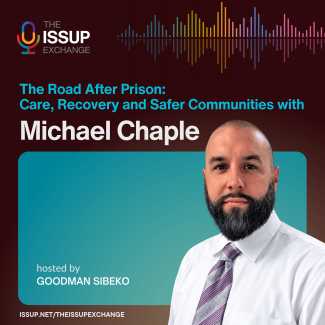
In this first episode of The Road After Prison: Care, Recovery and Safer Communities, Professor Goodman Sibeko is joined by Michael Chaple, an internationally recognised expert in correctional behavioural health, implementation science, and justice systems integration. Michael reflects on the experiences that shaped his career and his recognition that punishment and incarceration alone were not effectively reducing crime or supporting recovery.
They explore the relationship between substance use, mental health, and rehabilitation in correctional settings, and why these environments can provide an important opportunity to begin treatment. Michael also explains why re-entry planning should start during incarceration, with continuity of care and practical support in place before release to help people successfully return to the community.
Featured Voices
Host – A/Prof. Goodman Sibeko
ISSUP Global Scientific Advisor.
Head of Addiction Psychiatry, University of Cape Town.
LinkedIn: goodmansibeko
Twitter/X: @profgsibeko
Guest – Michael Chaple
Michael Chaple is an internationally recognised expert in correctional behavioural health, implementation science and justice-health systems integration. His work has focused on strengthening substance use and mental health services in correctional settings and improving continuity of care as people return to the community. Learn More>>
Time Stamps
Professor Goodman Sibeko (00:00)
Hello and welcome to The Road After Prison, Care, Recovery and Safer Communities, a special ISSUP podcast series exploring how treatment, transition planning, and coordinated systems can support recovery after incarceration while strengthening community safety. With our special guest, Michael Chaple, I'm Goodman Sibeko. I'm the ISSUP Global Scientific Advisor, and I'm your host. You can find me on LinkedIn and on social media just by searching for @ProfGSibeko, and you can find ISSUP on LinkedIn, X and Blue Sky simply by searching ISSUP.
Across four episodes, we will follow the journey from custody to community. We'll begin by getting to know Michael and exploring why re-entry planning starts during incarceration. We'll then turn to the critical first weeks after release, the systems and partnerships that sustain recovery, and the outcomes that matter during recidivism.
This is an international conversation. Models and resources differ across jurisdictions, but the underlying questions are widely shared. How do we prepare early, connect care across the prison gate, use existing resources well, and define success in ways that really reflect recovery, well-being, and safety?
Now, Michael Chaple is an internationally recognized expert in correctional behavioral health, implementation science and justice systems integration. His work has focused on strengthening substance use and mental health services in correctional settings and improving continuity of care as people start to return to the community.
Through his work with correctional systems, community providers, policymakers, and research, Michael's really supported evidence-informed approaches that are designed to improve recovery, reduce re-offending, and strengthen community safety.
Now, in this first episode, we'll begin with Michael's professional journey and the experiences that have shaped his work in correctional behavioral health, implementation science, and re-entry. We'll then look at why correctional settings are such an important opportunity for treatment, why substance use and mental health needs should be addressed together, and why successful reintegration really begins before the day of release. Michael, welcome. Thank you so much for being with us.
For listeners who are meeting or hearing you for the first time, who is Michael Chaple and what first drew you into this correctional behavioral health space?
Michael Chaple (02:21)
Thank you, Goodman, for having me. Well, so my career started off fairly early. I won't go through my entire existence in the field, but I think my original interest had to do with some struggles that family had and involvement in the justice system. Picked it up academically, but really the passion sort of grew as it was obvious early on that there was a significant need for reform with regard to the justice system.
It was clear that the system was perpetuating mass incarceration, operating with deep systemic biases, incurring massive financial costs, all while failing to reduce crime effectively. Whatever it is that we were doing wasn't working. We knew about the war on drugs. That was a significant contributor to the rise in prison populations here in the United States.
It was a specific reason why my family struggled and ended up in the situation they were in. People of color were disproportionately affected at every phase of the legal process. And so all of this at the same time where overwhelming evidence was emerging that getting tough on crime through harsh punishment did nothing to reduce or deter crime. So it wasn't working.
And so there was this recognition that there was an opportunity to focus more sincerely and intentionally on alternatives to incarceration and rehabilitation efforts, something that wasn't being done very well. And so that was really my goal, my passion.
Professor Goodman Sibeko (03:40)
That's amazing. And Michael, really your work spans clinical care, it spans correctional systems and also research and implementation science. I mean, that's quite a mixed bag in some contexts. You know, how did that journey unfold?
Michael Chaple (03:53)
Yeah, so I started off in research. I started off doing clinical trials, looking at substance use treatment interventions that were being implemented in correctional settings, primarily prisons across the country, various states. I've probably been in 50, 60 different prisons in a professional capacity.
Those studies were looking at the efficacy of implementing different cognitive behavioral programs in prisons and how feasible that was, how effective it was, what was the impact upon release on substance use. And then, you know, probably 10 years into my career, thinking that was going to be the rest of my career, we had an opportunity to work on some technical assistance projects, right? And where your ability to get into the community and work on implementation, right? You have all these evidence-based practices that have been proven in the literature. And then there's really little uptake of them in the field, right?
Like substance use treatment programs struggle to pick up evidence-based practices for substance use disorder. Correctional systems are the same. We worked on studies that they couldn't continue because they didn't have the capacity to implement them absent the research dollars. So really got a passion for implementation support in the context of other types of funding.
And to be honest with you, found that even more enriching because you're actually on boots on the ground, working in these facilities, helping them to implement real-life solutions, not sort of lab-facilitated solutions.
Professor Goodman Sibeko (05:21)
That's fantastic. So it's really looking at the whole ambit, what's required for sustainability and for scalability, isn't it? And so if you could look back, you know, what experience would you say most changed the way that you think about recovery and re-entry?
Michael Chaple (05:37)
For myself, honestly, and I really believe this for anyone in the field, the most influential factor has been and always should be knowledge of what works and what doesn't work. I know I firmly believe that as professionals, we're obligated to follow the science as objectively as is humanly possible. And so I learned early on in my career that everything we were doing, as I previously said, in the legal system wasn't working.
There are numerous justifications for punishment, whether it be retribution, incapacitation, deterrence. None of those things work. There's no evidence that deterrence works. There's no evidence that incapacitation works. Crime rates still don't go down just because incarceration rates go up. But rehabilitation, there's plenty of evidence that rehabilitation can work. It doesn't always work, but it can work. And we weren't investing any time in it.
And I found that, you know, puzzling. We have this great opportunity and we're not investing any time or energy around rehabilitation. And that's, you know, that's what I think should drive us as professionals in the justice field. It's critical. And otherwise, we're wasting an inordinate amount of time and money doing what we're doing, you know, with no results.
Professor Goodman Sibeko (06:46)
That's great, but so if we then look at rehab and other components, which I think we'll get into as we keep talking and also as we start digging into the topic, why is it that correctional settings are such an important opportunity for substance use and mental health treatment?
Michael Chaple (07:03)
Great question. And this is something that I think most people, even not associated with the field, could grasp. It's very fundamental. First, those involved with the criminal legal system are disproportionately impacted by substance use and mental health. It's a fact.
It has been estimated that approximately two-thirds of individuals meet the clinical criteria for an active substance use disorder that requires treatment, is what that means. And that's a rate ten times that of the general public.
Another 20% or so have committed a crime while under the influence as a means of getting money for alcohol or drugs, or as some kind of byproduct of the drug market in which they're involved, for example, the inherent violence of drug dealing.
So, likewise, approximately 40% of those incarcerated have a diagnosable mental health condition, with estimates being much higher when you look at symptoms and history. So behavioral health probably impacts 75 to 80% of people who are behind bars, under criminal justice supervision in the community, or whatever the case may be.
So there's clearly a need, a well-established need for treatment. Also consider the fact that many of these people have never received proper health care before. Many are looking to better themselves while in custody, if for no other reason than they have nothing else to do. A captive environment makes it more likely that people consistently attend counseling, medical sessions, whatever opportunities you put before them. There's significantly more motivation.
And of course, untreated behavioral health conditions will substantially increase the likelihood of reoffending. So we have all that opportunity. And if we do nothing, we have worse outcomes. It's really just completely fundamental. Of course, it's resource-driven, but it's something that we need to figure out.
Professor Goodman Sibeko (08:36)
So Michael, looking at that relationship between the higher prevalence of mental health conditions and the increased likelihood that someone might reoffend, for example, what do we really know then about the overlap of substance use disorders and mental health conditions, specifically amongst this population in correctional settings?
Michael Chaple (08:54)
Yeah, so I mean, if we're talking about integrated care, it's vital simply because these conditions often, you know, I just mentioned that there's plenty of prevalence of them in the legal system, but they often share similar root causes. And maybe even more importantly, they heavily influence one another. They don't operate in independent silos of each other within your body.
People with untreated anxiety or depression may use substances to make them feel better, something that we often term as self-medicating. This can lead to the development of a substance use disorder while doing nothing to remedy the underlying mental health condition. Conversely, heavy substance use can mimic or exacerbate mental health symptoms.
So if, for example, the approach to counseling is to address the drinking without addressing the anxiety or depression, that individual is likely to drop out of treatment when having to deal with the pain and the complications caused by their anxiety or depression.
Instead, integrated care addresses the whole person, including the shared causes of mental health and substance use disorders, such as, for example, trauma, is very common in the legal system. And when individuals receive integrated care that addresses both disorders simultaneously, including the interaction between them, they stay in treatment longer, enjoy greater overall stability, and experience fewer adverse events.
And it's true in the community as well.
Professor Goodman Sibeko (10:11)
So keeping that in mind, as one starts thinking about preparing for release, for going back to the community, you know, your work has really emphasized that successful re-entry really starts during incarceration rather than only at the point where someone is about to be released. What does this mean in practice? What does it mean for the interventions to start during and before they leave?
Michael Chaple (10:35)
Yes, you know, I will say that re-entry planning isn't simply about determining where an individual goes and what services they receive upon release. Most of my career, the model that I've seen is identifying some period pre-release, maybe three months, maybe one month, whatever the case may be, of people that are scheduled for release. And at that point diving in and saying, you know, what do you need? Well, how can we help you? If that. And that's not the way that it should be.
Most re-entry programs are structured that way. Instead, correctional facilities should be screening individuals upon entry into the system to identify their greatest needs and deliver interventions as possible throughout the period of incarceration to best prepare them for release.
Take substance use disorders as an example. There's a big difference in the likelihood of successful re-entry for the individual who receives treatment during or throughout the period of incarceration, who is then connected to further care upon release, continuity of care, right? That implies that you've actually gotten care before, and that individual who receives no treatment during incarceration and who's then referred to care upon release.
Not only has the opportunity to begin the recovery process sooner been wasted, but the individual whose needs have been neglected throughout the period of incarceration is extremely unlikely to perceive the need for treatment upon release, take a referral when they are burdened with so many other challenges as they get out of the facility. It's, you're just setting them up for failure.
Professor Goodman Sibeko (12:03)
You're really using that opportunity while they're incarcerated to remove their achievement naivety and start building their social capital, right? Before they have to go back to that same exposure that caused the initial, you know, diagnosis to begin with.
Michael Chaple (12:15)
Yes, absolutely. And, you know, recovery is a process and it's often, for many people, a long process. Why wait to start it?
Professor Goodman Sibeko (12:23)
Right. Absolutely. And, you know, how then does this treatment, you know, as you start the process before they get released, how does delivering it in a security-focused environment, which in many ways is designed to be restrictive, how do you do that in a meaningful way that prepares them for life after release?
Michael Chaple (12:41)
I mean, I think one of the biggest barriers at this point, and it's not a technical answer, but first and foremost, there needs to be a belief among corrections professionals that behavioral health service provision and rehabilitation more broadly is an important function of the legal system.
Historically, there's been a big philosophical divide between corrections and treatment, right? Corrections is about security, treatment is about rehabilitation.
This needs to change. Assuming there is buy-in toward rehabilitation, and this has been increasing in corrections over the years, they have to give credit where credit is due. But correctional institutions still have to navigate severe resource shortages, right? So this is the second layer.
Delivering behavioral health services within correctional institutions requires access to evidence-based therapies, medications, which is typically contracted out, or at least they have to bring someone on staff. They need money. They need expertise and, as such, inadequate funding could be a significant barrier to behavioral health care, especially, you know, in the legal system, which wasn't designed for that purpose initially.
Professor Goodman Sibeko (13:44)
So it's really about looking at custodial settings as what we would hope they are, as in they are rehabilitation, the rehabilitation of the individual's function in society, but in addition to that, they're public health rehabilitation as well. So it really should be part of the package.
Michael Chaple (13:59)
Ideally. Ideally. I think they operate more. I mean, there's this kind of, when you're young and you're in grad school, you talk about all the justifications for punishment, and I mentioned before, retribution, right? Payback. You've done something wrong, there's a moral obligation of society. Incapacitation, remove the threat, threats no longer exist. Deterrence. Deterrence doesn't work, specific or general.
I think we operate more as incapacitation centers than rehabilitation centers, right? Where we're, from a security perspective, removing the threat and we're not taking advantage of the time that we have these folks, because the reality is that 95% of people who are incarcerated will return to the community at some point. You know, the lifers and the people that never get out, they're the very small minority.
Professor Goodman Sibeko (14:43)
I think, you know, one thing that is apparent in general about the, you know, the health workforce, and I think about correction workforce as well, is they're also part of the communities that they return to as well at the end of their workday. And they have the similar concerns about security.
So it's also about selling to them the idea that rehabilitation is about the whole person, that it's not just about removing them from the community, but it's also making sure that when they go back into the community that they've reformed and they are better people.
And with that in mind, if correctional professionals remember just one principle about preparing for re-entry, in your mind what would that be?
Michael Chaple (15:19)
I mean, it's what we're talking about. Rehabilitation is critical to re-entry success. We have to make an investment in it. Without services aimed at supporting individuals in the re-entry process, the likelihood of recidivism is very high. And for far too long, the system has neglected the responsibility of rehabilitation.
You know, it's also about being able to provide for individuals adequately. Upon release, re-entry planning, I mean, you have potential needs that include but are not limited to securing vital records such as ID cards, birth certificates, social security cards. People can't do anything without these documents, yet they're continually released without them.
Basic needs such as food, clothing, and access to financial support, access to transportation, not only from the facility to wherever they're going, but to any appointments they're expected to attend. Stable housing is a huge one. We could go, we could have a whole podcast about that alone.
Health and behavioral health care that will often include Medicaid enrollment, making sure they have insurance when they come out so that they have access to medication continuity, treatment access, employment support, public benefits, family reunification. There's a lot of work to do and we just don't do nearly enough. You often hear about, here's $20 and a bus pass. And it's true in some places.
Professor Goodman Sibeko (16:33)
Wow. And we're gonna get into all of that as the series unfolds. So to our listeners, be sure to stay with us. Michael, thank you for helping us understand the journey behind your work and why preparation for re-entry must begin during incarceration with integrated treatment and a clear plan for the continuing care after release.
In the next episode, we will cross the prison gate and focus on the first weeks after release, the risks people face, what a genuine warm handover looks like and what the practical support that helps recovery continue in the community looks like. Stay with us as we continue this important conversation.
Thank you for spending this time with us. We hope you enjoy that as much as we do. Be sure to hop on over to our website, isop.net, where you'll find information on how to sign up for free membership. Take care and catch you on the next one.
__________
About the ISSUP Exchange
The ISSUP Exchange podcast series explores the evolution of responses to the challenges of substance& nbsp;use—from research and training to ethics, quality standards and evidence-based practice. We connect the dots so you can see the big picture.
Explore more episodes and join the ISSUP podcast community here>>>
About ISSUP
ISSUP is a global network that unites, connects, and shares knowledge across the substance use prevention, treatment, and recovery support workforce. Our mission is to make our members’ work as effective as possible—by providing access to training, resources, and a vibrant professional community.