
Faith, Identity and Belonging: Preventing Criminal Recruitment with Tim Rosier Pt. 1
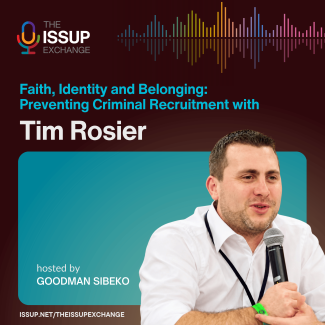
Part 1: From Youth Justice to Faith-Informed Prevention
What helps a person change, and what role can faith play in that journey? In this first episode, Tim Rosier joins Professor Goodman Sibeko to reflect on his career across probation, youth justice, prisons and academia, sharing experiences that challenged his understanding of crime, vulnerability and rehabilitation.
Tim explores the power of trusted relationships, the importance of looking beyond first impressions, and why faith and spirituality are often overlooked in criminal justice and prevention. He also considers how practitioners can engage with faith ethically and recognise its potential to support lasting change.
Featured Voices
Host – A/Prof. Goodman Sibeko
ISSUP Global Scientific Advisor.
Head of Addiction Psychiatry, University of Cape Town.
LinkedIn: goodmansibeko
Twitter/X: @profgsibeko
Guest – Tim Rosier
Tim Rosier is a freelance academic educator and consultant most recently a Senior Lecturer at the University of Derby. His professional journey spans probation, youth justice, prison work, public health and academic research. That combination of frontline and scholarly experience informs his interest in why some young people become involved in crime while others remain resilient in the face of similar adversity, and in how identity, belonging, faith and positive relationships may contribute to prevention and long-term desistance.
Time Stamps
Professor Goodman Sibeko (00:01)
Hello and welcome to Faith, Identity and Belonging: Preventing Criminal Recruitment with Tim Rosier, our special friend. This is a podcast series exploring how identity, belonging, faith and trusted relationships can really help protect young people from substance use, exploitation and criminal recruitment and importantly support lasting change for people seeking to move away from offending. I'm Goodman Sibeko. I'm the ISSUP Scientific Advisor and I'm your host. You can find me on LinkedIn and on social media just by searching for Prof. G. Sibeko. And you'll find ISSUP on LinkedIn, X and on Blue Sky by searching for ISSUP. Across four episodes, we'll move from Tim's professional journey to the pressures that make young people vulnerable, the role that faith and hope may play in desistance, and the partnerships needed to build communities in which young people can belong and thrive without being drawn into harm. This is not a conversation about replacing evidence-based prevention, treatment or criminal justice practice with faith. It is a conversation about whether faith, spirituality, and trusted community relationships can be engaged ethically, voluntarily, and is part of a wider evidence-informed response.
Tim Rosier is a freelance academic educator and consultant, most recently a senior lecturer at the University of Derby. His professional journey spans probation, youth justice, prison work, public health, and academic research. That combination of frontline and scholarly experience informs his interest in why some young people become involved in crime while others remain resilient in the face of similar adversity and how identity, belonging, faith, and positive relationships may contribute to prevention and to long-term desistance. In the first episode, we will look at Tim's journey through probation, youth justice, prison work, public health and academia. We'll explore the experiences that shaped his understanding of vulnerability and resilience and why faith and spirituality have often been difficult subjects within mainstream criminal justice and prevention conversations. Tim, welcome. Perhaps the best place to start is with your own journey for listeners meeting you or hearing you for the first time. Who is Tim Rosier? What drew you to this work for young people? And what drew you to your involvement with the justice system?
Tim Rosier (02:15)
Thanks, Goodman. It's really great to be with you today. So I suppose my journey starts back actually when I was a teenager, or even maybe earlier as a child, and listening to stories of my grandfather who was a police officer, I was enamoured and captured by the stories of what he got up to at work. And also by my own dad who works himself as a as a magistrate and has done for many, many years. And it was a trip to the courts to go and see the workings of a magistrates' court here in England.
That just inspired me and something captured me at that moment and said that's the journey I want to go down. And so I embarked on a journey of training. originally I undertook a law degree and was in interested in the criminal law. And then that expanded over a period of time later becoming a probation officer, which is really the foundation of my experience in the criminal justice system. And I loved working for the probation service. It's one of those jobs that has got a certain hallmark to it that's about a passion for people and seeing change realised. And within that experience I undertook a number of different roles. You know, the bread and butter run of the mill community supervision and supervising offenders but also had the fantastic opportunities to undertake various specialisms, working with prolific and priority offenders, working within the courts, the magistrates and the crown courts, doing liaison work with sentences and lawyers and so on.
And then later I undertook a number of secondments to the police and to multi-agency roles working in the counterterrorism related arena, doing intervention work with people who are at risk of radicalisation towards extremism and so on, and undertaking training roles, developing training materials for the police around that sort of area. So we did a whole range of different things within the probation service.
And then after that I embarked into the charity sector, working with an organization working specifically with young offenders within the prison context. and by young offenders I do mean both juvenile offenders, those under 18, but also here in England and Wales, those that are 18 to 21 and bridging into the young adulthood space as well. and I headed up a social franchise that placed youth workers within the prison context delivering outreach, youth work, detached youth work within prisons, non-formal education programmes through creative arts and so on, and doing chaplaincy support, providing chaplaincy support within the prison. So I did that for a whole number of years and saw some incredible things around a whole number of different young offender institutions in the country. And then most recent most recently I've then shifted into the academic space. As I say been a lecturer and a senior lecturer working in social and community studies, the public health, training social workers, youth workers, that thing as well. And more recently I'm picking up other work now, I'm I'm lecturing in law, going back to that whole full life circle, but also developing into freelance stuff, working around behaviour change and training practitioners. So I mean that's a bit of a potted history, but I suppose the thread that runs through it all is this interest and passion.
For what it means, what the word justice means is the in the criminal justice system. And it resonates with that personal belief really about the fundamental worth and dignity of everyone that we engage. And that was the thing I think is the thread that runs through all of my work is this is this passion for seeing people realise change and becoming you know active citizens free from the things that hold them back.
Professor Goodman Sibeko (05:25)
That's amazing. Your journey has clearly taken you through a few settings. It's taken you through probation, it's taken you through youth justice, through prisons and public health settings and now most recently academic. In your mind, what did each setting perhaps teach you that the others couldn't? So was there anything special that you learned from each setting?
Tim Rosier (05:45)
Yeah, there's definitely something I think when you when you look back, it's a bit like mountain walking. I don't know if ever your listeners go mountain walking. When you start at the bottom, you see the summit of the mountain and you're not necessarily clear about the path that you're going to take. You can see the destination, but you can kind of only perhaps see the first few meters. But it's only when you get to certain points along the journey that you turn around and look back that you have greater clarity about the path on which you come. You see things in a different perspective.
And certainly it's the certainly it's the case that every job and role and situation that I've been in, when I look back, I can see the connectivity between them, but not necessarily known looking forward how that's going to be the case. And there's certainly things that I've learned along the way. I mean, for example, even when one of the things I didn't mention for a short while, I was a music teacher in a secondary school, which I know is completely unrelated to criminal justice, but it was a part-time job early on in my career when I was also working as a youth worker.
And even in that setting there was a student who was just full of angst and anger and was you know, was challenging authority and so on and was going down a path that was really not helpful to her. And I took a different approach with her that was just much more relational. And in hindsight she just needed someone to believe in her and gently encourage her on her own path.
And to see the change at the end of the year, she became much calmer. Her mum even sent me in a box of chocolates as a thank you. It just showed me actually at a fundamental level that the relational element of our work cannot be underestimated. It's about trusting relationships and belief in people that can be the thing that I think can add really that special touch to any work that we do. We can get ourselves caught up with theory and models and so on, but at the heart of it is the relationship, is the belief in the person and seeing things from their point of view. I mean a another experience along the way as well, I suppose, when I was working in counter terrorism, I worked with this guy who was just so angry. He was caught up in paramilitary activity and violence and racism and had just been captured by this whole right wing ideology. And I won't go into much detail but
We ended up doing some intervention work with him that was one of the most profound experiences in my career today, where we took him to the Holocaust Memorial Museum here in England. And through an immersive journey through that museum, through that experience and the space to have questions, he was confronted with his own anger and his belief and his experience.
And it was a privilege to journey with him and he got to a point where he just broke down in tears. And later on that day we sat down and had a three way conversation between him, a Holocaust survivor, an elderly Holocaust survivor and myself. And I just sat back and let this let the conversation happen. And again it's about I suppose again the power of relationship, the power of journey, but also about
looking for the unexpected opportunities that fall outside of nice neat models and so on. And then sometimes it's about being vulnerable and getting down into the place where it hurts a little bit in order to facilitate stuff that comes through. So and there's many experiences I've had even just working in probation and prison since. But I think at its heart, as I say, is about relationship, it's about trust, it's about seeing, I think, the precious stone within somebody, even when perhaps you're first confronted with all sorts of negative stuff. Yeah.
Professor Goodman Sibeko (09:06)
It really sounds to me like these stories illustrate how you started then to start formulating how you wanted to ask questions and how you wanted to think about the interrelatedness and the importance of engaging at that level. Looking back, I guess, as an extension of that point, which experiences would you say most shaped your thinking about how or why some young people might start becoming involved in crime while others remain resilient despite similar adversity.
Tim Rosier (09:33)
Yeah. I think, looking back, very often the image that you're presented with when you meet a service user, a person for the first time, it's really important that you don't take that as the fur as the reality. Because very often they're projecting pain, trauma, self-preservation, there's all sorts of stuff. And it's really important to try and look behind that exterior to what's going on the root cause. And I suppose looking back the experiences that I've said, you know, those examples I think just shows that actually often there's more to a person than meets the eye. And I think very often, particularly in criminal justice circles and particularly prison, we can fall into the trap of there being double punishment. You know, very often victims are sorry, offenders are victims themselves. And that's not to excuse their behavior of the offending. Obviously they have to be held accountable for that within criminal justice systems, but it's about understanding that behind them very often there's a hurting person. Hurt people, hurt people, is what they say. And very often the victims themselves would need the help and support to overcome that trauma and just somebody to believe in them and to rather than exacerbate that deep-rooted pain, find ways of teasing that out and getting to the real person, the real nub of the issue. And what I've seen is that prison in particular, the hopelessness of prison and the damage that it does far outweighs actually any rehabilitative benefit that can come from that.
And I just believe that people have so much potential if they're able to choose a different path and actually our responses as practitioners and as systems. We'd sometimes we just need to keep ourselves in check and not add to that. And I think one of the things that I'm passionate about is about rehumanising a system, seeing the person, the individual person that we're engaging with and who they really are as a starting point for engagement. So I think looking back, that's certainly with young people that's that's really what I've tried to do, and I've learnt along the way that I've often been wrong about my first impressions. When I've got to know people, actually the issue's not what I necessarily thought it was.
Professor Goodman Sibeko (11:28)
That sounds like our first big takeaway from the series already is like, don't take the first impression as someone's entire reality. And I think the thread that we certainly try to do, you know, carry through at ISSUP and I think the theme for what you've spoken about is really rehumanization and focusing on the whole person and how you can really be focused on them. Considering this and some of, you know, the experience you've spoken about already,
How would you say that your understanding of prevention has changed over the course of your very colorful career so far?
Tim Rosier (11:57)
I think prevention's often more complex than it's framed to be. I think po often prevention is seen as sort of upstreaming and as a quick fix and if you do this it diverts people away. But as I say, people are often complex beings with deep-rooted trauma and pain and a vr and you know quite an interesting story. So I think it's my understanding of prevention is that it's often more complex and therefore it requires resources and a different response that sometimes is perhaps the hardest. it's not the most expedient just to do a sanction and actually to get into the real work of getting to know people is is sometimes i it's tricky, it's hard, it's it's traumatic. so it does require resources that are often hard to pr to provide. But also I think also in our neoliberal structures as well, this sort of work is really is much harder to evidence.
And to meet KPIs and so on. So when you're getting involved with things, for example, if you're sending somebody on a programme, you can measure their attendance or attrition or completion of that programme. But prevention work, the discussions about the getting to know people is much harder to evidence. and so I think that's a real challenge that within pressured systems, we can we can sort of shy away from that towards quick fixes. and I suppose the other thing about prevention is that it and we've touched on this already, is
The best tool in the box is yourself, is the trusting relationship that you can form with the service user. And that trusting relationship needs to happen over the long haul and it needs to be holistic.
Professor Goodman Sibeko (13:26)
Tim, that focus on the self, it then leads nicely into what I wanted to ask you next, really about social capital, isn't it? So you bring yourself and you bring your environment, you bring all the things that make you and that support your identity and your development. have to think, keeping that in mind, was there a defining moment for you? That sparked your interest specifically in faith, spirituality and desistance.
Tim Rosier (13:50)
Yeah, I think I think there certainly is. there's there's the there's the personal and then there's the professional experience that I can bring to this. I mean, at a personal level, I suppose my own experience of faith, and I you know, perhaps I should to highlight this as my own positionality that I am a Protestant Christian in the free church tradition in England. I would describe myself as having an active rather than a cultural faith, and that's come through own life experiences as well.
Rather than just perhaps a family tradition or an expectation of my culture and community. And so my own experiences of faith certainly shape the person that I am and therefore shapes my motivation, my approach, my beliefs, my value system that I bring to the table as a professional, as an engaging when I engage with people. So it's certainly at a professional level that's the case. But there's certainly been it are perhaps two significant experiences along the way that have shaped my understanding and giving me perhaps a framework of language to describe that. And one is the story of Sarah, who that's not her real name, but it was a case that I supervised when I was a probation officer. And it was one of the most profound cases again that I've supervised where she was caught in a destructive cycle with her partner at the time of alcohol use, which then led to domestic violence.
Which was then cyclical and she was just caught in this cycle every week. During the weekdays that we're a functioning family on the face of it. But at weekends when alcohol got out of control, she was in this destructive cycle and was beaten up and there was lots of shouting, screaming, fighting, physical assault and so on. And on one occasion Sarah something snapped in her and she in self defence, while drunk, reached for a bread knife in the kitchen and stabbed her partner, nearly killed him.
It was a horrific injury and she was arrested for this spent months because that months waiting to see the outcome because it wasn't she wasn't quite sure what was going to happen to her partner. luckily he did survive. Now what was interesting then was that while she was waiting on bail for the sentencing for the process, the sentencing process and so on, she had a religious experience, a faith experience through a family member where
Some might call it a Damascus Road experience, others might call it a conversion experience, but she just had a profound change of heart and sense of direction. And it changed the person she was. So as the probation officer who later on was tasked with writing the pre-sentence report, I saw this massive transformation in her that there was no words to describe that. There was no outcome for a programmeme. The change was so dramatic.
And actually what I saw was this huge change and the court saw this. And actually the sentence she received allowed her to move forward with positivity. And now that the outcome was that she ended up marrying the guy she stabbed. The relationship was restored, and she now gives her life to serving the community she lives in. And she makes she runs various projects through her local church to do that. And everyone can see the change in her. And that was a profound experience.
While I was working as a probation officer. And more recently when I was working within the charity sector, you'd hear a stories time and time again about radical transformation taking place among some of the hardest prison population. And at the root of it was that relationship with somebody who believed in them and journeying with them and experiencing something about a real faith, what faith can bring to the party. And whether that was they saw something different in the people that they were working with, or whether they experienced their own faith moment. But there were many stories, many stories of how change that you couldn't explain by a like a programme or an intervention would bring about. And I've seen many, many times people change to be completely new versions of themselves.
Professor Goodman Sibeko (17:25)
It sounds to me like the judicial process managed somehow to take stock of Sarah's change, which is wonderful because it allowed for a more sympathetic response to her situation.
Tim Rosier (17:36)
Well, the judge in that case absolutely saw that and he saw that with his own eyes from the person who was initially in court to, you know, various changes along the way. And I saw that and my own comments in my pre-sentence report added to that. And the judge took a decision on that day, I think, that really captured for me what justice means. He didn't just see her current predicament at the time of the offence as the point at which she should sentence, but he saw her future potential.
And the change that took place. And so sending her to immediate prison would have undone that. He gave her a suspended sentence order, which was highly unusual, but recognised the change and cemented the opportunity to further that development. So the judge the judge was bold in his sentencing that day.
Professor Goodman Sibeko (18:17)
So I wonder, so clearly there was in that process, you know, exposure to the visible change that caused the change and how the process unfolded. I wonder whether this infers that there are conversations taking place about faith or if not, why would you, you know, what do think some of the reasons might be that conversations about faith are often either absent or approached in a hesitant, cautious way in the mainstream criminal justice system and also in public health and prevention practice in general.
Tim Rosier (18:48)
Yeah, I think that's a really interesting question to grapple with. And I think there's probably a number of reasons. and I'm conscious that your listeners are obviously from all over the world, but my own position working in the UK, I think our cultural context is that we're we're increasingly a secular society and that has an impact on how people feel that they can talk, on the training, on the outcome on professional work. So I think increasingly, and this ha this has recently changed actually, but I think, over the last perhaps forty, fifty years, I think in the UK, it faith has been something that seemed to be a personal matter and shouldn't be in the public square. And I think that's pervasive at every level from the political level. You know, I remember Alistair Campbell who was a Labour communications guide to the Tony Blair government said, you know, famously, We don't do God.
And it's pervasive through to professional training, university level training that in secular training spaces such as university, that impacts on the content and the confidence that people have of professional training, right through to the public square. And there's many, often many examples of how people have been taken to employment tribunal for expressing their faith. So I think that leads to an ignorance and a fear within populations around how the challenge of competing views can come about. So that so very often I think there's a ranking of protective characteristics and faith is often seen put sometimes at the bottom of the pile and that feeds into that sense of fear. But also I think as well is that there's a there's a suspicion and a fear of faith that faith is often talked about, but it's talked about as a problem. The problematization of faith.
So faith often is only talked about as an either as a problem to be fixed or a risk to be managed. So let me give an example. Very often in probation circles, certainly for a period of time, Islam was synonymous with the prevent agenda, the counterterrorism strategy, for example. And or there might be more widely in health or public health circles, Jehovah's Witnesses would be talked about, you know, in terms of the refusal to give blood transfusion or receive treatment.
Or there might be perhaps more fundamental or conservative faith groupings views on human sexuality would be s a challenge and a problem. So sometimes I think p faith is often talked about as a problem rather than seeing it with the as the potential and as a potent force for good. So I think cultural context and the fears that come from that are a huge part of that.
Professor Goodman Sibeko (21:06)
What is faith and what is faith not?
Tim Rosier (21:08)
Wow, that's a deep question. I think what is faith? So I think what can be often helpful here is Newman's model of faith, religion and spirituality. And I think of it as a little pot plant. Newman talks about these three things that they're all linked, but they're actually very distinct. And I think sometimes words like faith, religion, spirituality can be talked about interchangeably and mean different things to different people. But Newman talks about faith as the knowing, it's the roots, the internal roots of a person's belief system. And it's foundational for the spirituality and the religious outworking of that. So faith is deeply personal, it's the roots, the experiences that lead to the value set. religion talks about is the doing of faith. So it's the outworking, it's the practical outworking of that inner faith.
So that might be the interactions with other adherents, it might be the attendance at places of worship, it might be the engagement with sacraments or you know particular rituals. And then spirituality is about the being of faith. It's the life journey, it's the journey of how that then informs the decisions that one person makes every day.
It's the spiritual, it's the mindset, it's the outworking, it's that it's the what they feel and experience in the day-to-day. Now, all of those three things are linked in, linked together, and actually together they feed off each other and therefore for a person grows in this area. But at its heart, faith is the roots, the belief and the trust in something outside of yourself, in the fullest sense of the term, that then shapes a person's holistic being that then leads to the religious outworking and the spiritual experience in the day to day.
Professor Goodman Sibeko 22:55
As we go towards the closing of this episode, what would you want practitioners to hold in mind as they consider how to integrate faith in their interventions.
Tim Rosier (23:04)
Yeah, I suppose I would encourage practitioners to be reflective and reflexive in their thinking and realise that we're actually all working within a cultural context and our cultural context shapes our own sense of perhaps belief as well, but also governs to an extent how we do business as professionals. there are the things that are perhaps unsaid or unseen that are influences to our own practice and I said about how in the UK, at the secular society, increasingly secular society shapes those things. So I'd encourage perhaps people to think about their own cultural context and to try and think outside of that and challenge those things, as well as also being reflective about their own positionality. What are their own perhaps prejudices or positive experiences that shape the way that they view this whole area of faith. Within professional practice in this area. So I think it's important to start to think about those things and just reflect on what is our positionality and how is it shaped by those things around us.
Professor Goodman Sibeko (24:02)
Amazing, Tim. This whole podcast has made me be more reflective of my positionality around all the topics that we discuss at the ISSUP Exchange. So, Tim, thank you once again for helping us understand the experiences behind your work and for locating faith within, but not outside, professional and evidence-based practice. In the next episode, we're going to turn to identity and belonging and why these needs matter so much during adolescence, how criminal networks can exploit them, and what families, schools and communities can offer in their place. Stay with us as we continue this important conversation.
Thank you for spending this time with us. We hope you enjoy that as much as we do. Be sure to hop on over to our website, isop.net, where you'll find information on how to sign up for free membership. Take care and catch you on the next one.
About the ISSUP Exchange
The ISSUP Exchange podcast series explores the evolution of responses to the challenges of substance use—from research and training to ethics, quality standards and evidence-based practice. We connect the dots so you can see the big picture.
Explore more episodes and join the ISSUP podcast community here>>>
About ISSUP
ISSUP is a global network that unites, connects, and shares knowledge across the substance use prevention, treatment, and recovery support workforce. Our mission is to make our members’ work as effective as possible—by providing access to training, resources, and a vibrant professional community.