ISSUP Africa Youth: World Health Summit Regional Meeting 2026
Headline
The World Health Summit (WHS) Regional Meeting 2026 was held from April 27–29 at the United Nations Office at Nairobi (UNON). Reimagining Africa’s Health Systems.
Purpose of the Event.
The World Health Summit Regional Meeting 2026 convened global and regional health leaders at the United Nations Office at Nairobi to advance Africa-led priorities in global health. The summit centred on aligning health discussions with regional realities, strengthening cross-sector collaboration and promoting evidence-based solutions to both emerging and longstanding public health challenges. It also aimed to elevate Africa’s voice in shaping global health policy and improving health outcomes across local, regional, and global levels.
Discussions were anchored across critical themes, including health security and resilience; digital health and AI-driven innovation; health workforce development, financing, and systems strengthening; youth leadership and social accountabilityand the broader social determinants of health. The presence of high-level stakeholders, including President Of The Republic of Kenya His Excellency, William Ruto and Director-General of the Africa Centres for Disease Control and Prevention (Africa CDC) DR. Jean Kaseya, alongside policymakers, academia, civil society, professionals and private sector actors, underscored the summit’s strategic importance as a platform for coordinated, multi-sectoral action in advancing public health across the continent.
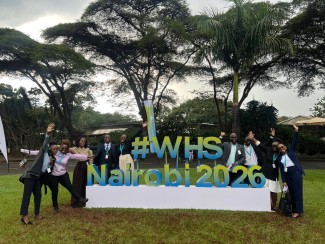
The World Health Summit Regional Meeting 2026 was a critical platform for advancing youth priorities within Africa’s evolving health landscape, reinforcing the need for stronger youth inclusion in health governance. A delegation of 10 ISSUP youth representatives participated, contributing to dialogue and representing youth perspectives across key sessions. Their engagement foregrounded the role of youth in shaping responsive, context-driven health systems, setting the stage for deeper conversations on youth health governance in Africa within a more contextualised and regionally grounded framework.
Youth Health Governance.
Youth health governance in Africa is increasingly shifting from youth engagement toward youth co-governance, where young people are not only present in conversations but expected to contribute to shaping systems. Yet a key tension remains: youth are often positioned as drivers of innovation, but not consistently included in governing structures that define priorities, resources, and accountability. In many cases, youth participation remains limited to side events and consultative spaces rather than core decision-making platforms. This raises a critical question: as youth health governance moves beyond representation, awareness, and participation, will youth be meaningfully positioned inside this shift as co-governors of health systems, or will they remain on the periphery of the structures they are helping to transform?
Forward View.
The World Health Summit Regional Meeting 2026 in Nairobi reinforced a reality that is already visible across youth health and prevention spaces: youth are consistently central to health and drug demand realities, yet still not consistently embedded within the governance and technical systems that shape responses. This is not a new gap, but it is now more urgent as global health continues shifting from engagement toward co-governance.
The direction is clear. Youth health governance must move beyond participation as an activity toward integration as a structure. This means embedding youth within decision-making and technical processes, ensuring youth are part of the full policy cycle, strengthening youth-led data and accountability systems and recognising youth as contributors to prevention science, mental health and drug demand reduction systems.
The key reflection from WHS 2026 is simple: taking space is not about being present in conversations, but about consistently positioning ourselves within the systems that design responses, allocate resources and define what effective prevention and youth health governance actually looks like in practice.When youth health governance is effectively realised the result is a more stable and responsive health ecosystem, where governance is continuously informed and future-oriented.