
Tussi (“Pink Cocaine”) in Medellín: Availability, Delivery Methods, and Overdose Risks
Tussi (“Pink Cocaine”): Availability, Delivery Networks, and Public Health Risks in Colombia
A January 2026 field-informed public health report
By Benjamin Zohar, NCACIP
Executive Overview
Tussi, commonly referred to as “pink cocaine”, is an informal market label used to describe a range of synthetic drug mixtures that originated in Colombia in the mid-2000s. Despite its name, chemical testing and clinical reporting indicate that Tussi rarely contains cocaine. Instead, it typically consists of varying combinations of synthetic stimulants, dissociatives, and other psychoactive substances.
By January 2026, Tussi has become widely available in urban nightlife settings, particularly in Medellín. Its normalization, professionalized delivery networks, and expanding user base represent a growing public health concern. The absence of standardized composition, combined with limited emergency response tools, increases the risk of overdose, medical complications, and legal consequences.
This report is informed by direct field experience in Colombia, engagement with treatment professionals and community stakeholders, and observation of evolving drug market structures. It documents how Tussi is accessed and delivered, outlines pricing and enforcement realities, and examines the health implications associated with current patterns of use.
Field Perspective and Context
During professional work conducted in Colombia, including participation in public-facing education and prevention efforts, it became evident that substance use patterns, risk perception, and treatment engagement are shaped by local cultural and legal contexts. Dialogue with community representatives, health advocates, and public officials—including former Antioquia governor Luis Pérez Gutiérrez—highlighted the need for responses grounded in local realities rather than external assumptions.
One recurring observation was a disconnect between how visitors perceive drug-related risk and how substances are regulated and enforced locally. This disconnect has contributed to preventable harm, particularly among international visitors unfamiliar with Colombian law and emergency response limitations.
Composition and Variability of Tussi
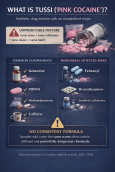
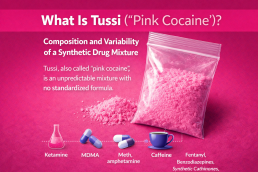
Tussi does not refer to a single chemical substance. It functions as a market designation applied to mixtures that vary by producer, location, and time. Products sold under the same name may differ significantly in composition, even when distributed through the same network.
Commonly Reported Components
- Ketamine
- MDMA (3,4-methylenedioxymethamphetamine)
- Methamphetamine
- Caffeine
Increasingly Detected High-Risk Additives
- Fentanyl and other synthetic opioids
- Benzodiazepines
- Synthetic cathinones
- Levamisole
The absence of a standardized formula creates false expectations of predictability. Familiarity with the name or source does not indicate safety or consistency.
Availability and Distribution in Medellín
By the mid-2020s, Medellín emerged as a primary urban center associated with Tussi availability. The substance is most frequently encountered within nightlife and party environments, including clubs, private events, and tourist-oriented districts.
Observed Distribution Patterns
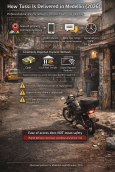
Tussi distribution increasingly resembles a service-based delivery model rather than traditional street-level markets.
- Orders placed via encrypted messaging applications
- Menu-style listings with branded variations
- Motorcycle courier delivery, often originating from industrial zones
- Delivery windows commonly ranging from 30 to 60 minutes
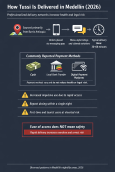
This model lowers psychological barriers to use, facilitates repeat dosing within a single night, and expands access to inexperienced users.
Pricing and Market Signals
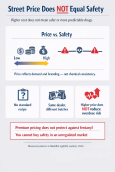
Observed street pricing in early 2026 commonly included:
- Approximately 70,000 COP for one gram
- Discounted pricing for multi-gram purchases
Price does not correlate with purity, safety, or reduced overdose risk. Higher cost products often reflect branding, demand, or perceived exclusivity rather than chemical consistency.
Law Enforcement and Legal Environment
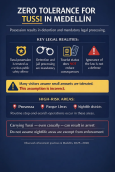
Law enforcement authorities in Medellín apply a strict approach to the possession and distribution of synthetic drugs, including substances marketed as Tussi. Enforcement intensified during the 2020s in response to overdose incidents, public safety concerns, and tourism-related harm.
Observed Enforcement Practices
- Zero-tolerance enforcement in nightlife districts such as Provenza and Parque Lleras
- Possession treated as a public safety offense
- Detention and legal processing commonly applied
- No exemptions based on tourist status or claimed personal use
Many visitors underestimate legal risk, assuming casual possession will be ignored. Field observations and public reporting do not support this assumption, and incidents involving foreign nationals—particularly Americans—have increased.
Health Risks and Emergency Response Limitations
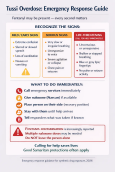
The health risks associated with Tussi are amplified by both its unpredictable composition and structural limitations in emergency response capacity.
Acute Health Risks
- Overdose related to opioid contamination
- Cardiovascular stress from stimulant combinations
- Respiratory depression from opioid–benzodiazepine interactions
- Hyperthermia in crowded nightlife environments
Naloxone Availability in Colombia
Naloxone, an opioid overdose reversal medication, is approved for medical use in Colombia but remains limited in availability. Distribution is largely confined to hospital settings and small-scale or pilot harm-reduction initiatives. Public access is restricted, and first responders do not universally carry naloxone as part of standard emergency equipment.
Regulatory requirements, cost barriers, limited training infrastructure, and inconsistent supply have been identified as obstacles to broader deployment. These limitations are significant in the context of increasing exposure to opioid-adulterated synthetic drugs.
Comparative Overview: Naloxone Access by Region
| Region | Public Access to Naloxone | First Responder Carriage | Community Distribution Programs |
|---|---|---|---|
| Colombia | Limited / Prescription-based | Not standardized | Small-scale or pilot programs |
| United States | Widely available (often over-the-counter) | Standard for EMS and police | Widespread |
| Canada | Free public access | Standard for emergency services | Nationwide programs |
| Selected European countries | Variable, expanding access | Common in high-risk regions | Established harm-reduction networks |
Public Health and Treatment Considerations
Public health approaches to synthetic drug use emphasize reducing morbidity and mortality rather than endorsing substance use. Harm reduction strategies are widely recognized as essential components of prevention, particularly where emergency response capacity is limited.
Recommended Priorities
- Accurate education emphasizing unpredictability and legal risk
- Expansion of overdose recognition and response training
- Increased access to treatment and early intervention
- Culturally informed outreach that reflects local realities
Treatment considerations related to polysubstance exposure and delayed recognition of dependence have been discussed by organizations such as Every1 Center and the Long Island Rehab Helpline & Crisis Intervention, which highlight the complexity of synthetic drug-related presentations.
Conclusion
By the mid-2020s, Tussi transitioned from a localized phenomenon to a broader public health issue in Colombia. Its normalization within nightlife settings, professionalized delivery networks, strict enforcement environment, and limited emergency response tools create intersecting risks for both local populations and international visitors.
Effective responses require accurate information, culturally grounded prevention strategies, and accessible treatment services that reflect conditions on the ground rather than assumptions imported from other contexts.