Іздестіру
Words Matter: Language and Stigma Reduction
New Psychoactive Substances: Studies from Central Asia and China
Recommended Reading: New Psychoactive Substances: Studies from Central Asia and China
We are pleased to present the book "New Psychoactive Substances: Studies from Central Asia and China", prepared by an international team of experts and...
Impact of opioid maintenance therapy in the community on re-incarceration in individuals with opioid use disorder—A linked cohort study
Abstract
Introduction
Studies have found associations between Opioid Agonist Maintenance Treatment during incarceration and reduced recidivism among recently released formerly incarcerated persons. However, the role of community-based Opi...
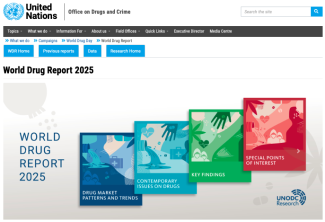
World Drug Report 2025
On July 2nd, 2025, ISSUP had the privilege of hosting a webinar outlining highlights from the 2025 edition of the World Drug Report (WDR), presented by Ms. Giovanna Campello, Chief of the Prevention, Treatment and Rehabilitation Section at...
A Call for Trauma-Informed Justice Reform in Nigeria: Breaking the Cycle of Substance Use, Mental Illness, and Incarceration
By Seye Omiyefa
Across Nigeria and many parts of the world, thousands of individuals, particularly youth and economically marginalized people, are trapped in a revolving door of arrest, incarceration, and reentry. Much of this cycle is...
Making a Difference Across Illinois
BOOSTING TREATMENT SUCCESS & VALUE
People referred to substance use treatment by the justice system (courts, probation, parole) are significantly more likely to complete it when they also receive TASC (Treatment Accountability for Safer...
Evaluating the effectiveness of mindfulness-based interventions in incarcerated populations: A meta-analysis.
Abstract
A growing body of research supports the use of mindfulness-based interventions (MBIs) in incarcerated populations; however, treatment effectiveness remains unclear. This meta-analysis of 22 studies (N = 2,265, 75% male) quantified...
Effectiveness of motivational interviewing with justice-involved people: a systematic review and meta-analysis.
ABSTRACT
Objective:
Motivational interviewing (MI) is increasingly recognized as an effective approach in forensic settings, particularly for overcoming resistance by avoiding confrontation and fostering intrinsic motivation. Research...
A systematic review of motivational interviewing to address substance use with justice-involved adults.
Background: Motivational Interviewing (MI) is widely used in substance abuse treatment, possibly due to the short sessions and the treatment’s cost-effectiveness. Previous research has established the efficacy of MI among a broad range of...
A quasi-experimental evaluation of Thinking for a Change: A “real-world” application.
Abstract
Due to the popularity of cognitive behavioural interventions, programs that follow this model are often assumed to be effective. Yet evaluations of specific programs have been slow in coming. The current investigation seeks to...
Thinking for a change 4.0.
About the program:
Thinking for a Change 4.0 (T4C) is an innovative cognitive behavioral change program crafted by experts Jack Bush, Ph.D., Barry Glick, Ph.D., and Juliana Taymans, Ph.D., in partnership with the National Institute of...
Engaging vulnerable populations in drug treatment court: Six month outcomes from a co-occurring disorder wraparound intervention.
Abstract
Objective
Although drug treatment courts (DTCs) have demonstrated positive outcomes, participants with co-occurring mental health and substance use disorders (CODs) are a high-risk group that often struggle with treatment...
The MISSION-criminal justice treatment manual.
In order to effectively implement MISSION and maintain program fidelity, model-specific treatment manuals and consumer workbooks have been created. Each treatment manual is a comprehensive how-to guide for case managers, peer support...
Evidence-based treatment and supervision practices for co-occurring mental and substance use disorders in the criminal justice system.
ABSTRACT
Background:
Over seven million persons in the United States are supervised by the criminal justice system, including many who have co-occurring mental and substance use disorders (CODs). This population is at high risk for...
A randomized controlled trial of moral reconation therapy to reduce risk for criminal recidivism among justice-involved adults in mental health residential treatment.
Abstract
Objective: Moral reconation therapy (MRT) is a cognitive-behavioral intervention to reduce risk for criminal recidivism. Despite being implemented widely in correctional settings, there are no randomized controlled trials of MRT...
Effectiveness of psychological interventions in prison to reduce recidivism: A systematic review and meta-analysis of randomised controlled trials.
Summary
Background
Repeat offending, also known as criminal recidivism, in people released from prison has remained high over many decades. To address this, psychological treatments have been increasingly used in criminal justice settings...
Evidence-based treatment and supervision practices for co-occurring mental and substance use disorders in the criminal justice system.
Abstract
Background: Over seven million persons in the United States are supervised by the criminal justice system, including many who have co-occurring mental and substance use disorders (CODs). This population is at high risk for...
Deflection and pre-arrest diversion: A newly emerging field in the United States.
Pre-Arrest Diversion Is the “Handle” on the Front Door of the US Justice System.
Many people can be safely deflected in the community instead of entering the justice system.
A scoping review of community-based post-opioid overdose intervention programs: implications of program structure and outcomes.
Abstract
Background:
An emergent intervention to address the opioid epidemic is the use of multidisciplinary outreach teams which connect an individual in the community to healthcare resources after the experience of an opioid overdose...