
Advertising, Digital Marketing and Betting: Their Impact on Public and Mental Health
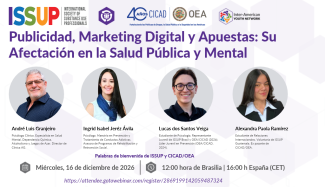
ISSUP Global and the ISSUP Youth Network, in collaboration with CICAD and the Youth Network, present a webinar on Advertising, Digital Marketing and Betting: Their Impact on Public and Mental Health.
Date: Wednesday, 16 December 2026
Time: 12:00 Brasília time | 16:00 Spain time (CET)
Language: Spanish, with interpretation available in English and Portuguese.
In recent years, the Brazilian betting market has undergone rapid transformation, particularly following Law No. 14,790/2023 (the "Bets Law"), becoming a commonplace, digital and widely advertised activity, including among adolescents and young people. This webinar will address Gambling Disorder, recognised by the DSM-5 and ICD-11 as an addictive disorder, and the ways in which advertising, digital marketing and the very architecture of betting platforms draw young people into this activity, in a context of vulnerable age-verification systems and the continued presence of the illegal market.
Recent data on Brazilian adolescents' access to betting will be presented, alongside the existing regulatory framework (such as the prohibition of betting advertising directed at children and adolescents and the Digital ECA), the main clinical warning signs and prevention strategies. Finally, the discussion will explore why this phenomenon constitutes a public health problem, rather than merely an individual health issue, in light of factors such as its growing prevalence, its negative effects on families, and the existence of commercial and environmental factors that can be addressed collectively. The session will include time for discussion and questions from the audience. This topic is relevant because it connects established prevention approaches in the field of psychoactive substances with an emerging problem affecting the mental health of adolescents and young people throughout Latin America.
In Guatemala, the regulatory framework for gambling faces a significant legal gap. Although the 1973 Penal Code (Article 477) penalises unauthorised betting with prison sentences and fines, gambling operates in a semi-legal context or under partial licences granted by the Ministry of the Interior for in-person events, fairs and slot machine venues. Essentially, the National Lottery is the only gambling activity that has operated legally under a formal state contract since 2005. In the physical environment, casinos and entertainment establishments are governed only by general obligations to the SAT, municipal licences and IVE controls aimed at preventing money laundering. However, the absence of a specialised authority and sporadic audits leave significant regulatory gaps, increasing risks such as corruption, a lack of financial transparency and inadequate user protection.
This regulatory fragility is further intensified in the digital environment, where Guatemala entirely lacks local regulation, an online licensing system and state-level blocking mechanisms. As a result, it is estimated that 40% of Guatemalan bettors access foreign platforms without restrictions (licensed in jurisdictions such as Curaçao, Malta or Gibraltar) through mobile devices and social media. The shelving of Legislative Initiative 4294 in 2016 (which sought to establish the National Gaming Commission, regulate online betting and introduce specific taxes) left the country without tools to require strict age verification, curb misleading marketing or limit the proliferation of addictions. This continuous exposure leaves young people unprotected against betting platforms designed to keep them engaged, placing them at risk without any controls or safeguards to protect them.
Consequently, the absence of a modern and specialised law extends beyond the legal and commercial sphere to become an emerging public health and mental health problem in Guatemala. In the absence of mandatory responsible gambling protocols, deposit limits or self-exclusion mechanisms, Gambling Disorder (recognised by the DSM-5 and ICD-11 as a non-substance-related addictive disorder) spreads without an adequate institutional response. High exposure to advertising and easy digital access act as determinants that trigger anxiety, depression, severe debt and family dysfunction among young people. Since the state does not collect specific industry taxes that could be allocated to the hospital network or community programmes, the public health system lacks the infrastructure to address these addictive behaviours, making a preventive, ethical and comprehensive approach similar to that used in the field of psychoactive substances urgently necessary.
Target Audience:
-
Young people, prevention leaders, health professionals and anyone else interested in the topic.
Learning Outcomes:
By the end of the webinar, participants are expected to be able to understand the relationship between advertising, digital marketing and betting, and their effects on mental health and public health; recognise Gambling Disorder as an addictive disorder and identify its main warning signs; understand the Brazilian regulatory framework for betting, including restrictions on advertising directed at children and adolescents; and recognise the role of families, schools and communities, as well as the importance of population-based prevention strategies similar to those already established in the prevention of psychoactive substance use.
Presenters:
André Luis Granjeiro
André is a clinical psychologist and specialist in Mental Health, with a focus on Substance Use Disorders, Alcoholism and Gambling. He graduated in Psychology from Anhanguera Educacional in 2017 and has postgraduate studies in Mental Health, specialising in Substance Use Disorders, at UNIFESP/UNIAD; in Psychological and Clinical Assessment, at Kroton; and in Traffic Psychology, at UNIP.
He is currently the owner of Clínica AG, located in Campinas (SP), where he provides in-person, online and home-based services focused on mental health, substance use disorders, alcoholism and psychological assessment. He also works as a coordinator and instructor in Therapeutic Accompaniment (TA) training programmes, in addition to being an accredited expert for psychological assessments related to the National Driver's Licence (CNH) by DETRAN, and for firearm possession by the Federal Police. He is a partner at RA4 and is currently undertaking psychotherapy training in the Psychiatric Nursing Department at the State University of Campinas (UNICAMP).
In the institutional and scientific field, he is a member of the Brazilian Association of Studies on Alcohol and Other Drugs (ABEAD) and the International Society of Substance Use Professionals (ISSUP), the International Society of Professionals for the Prevention and Treatment of Substance Use.
Ingrid Isabel Jeréz Ávila:
Ingrid is a psychologist graduated from the University of San Carlos of Guatemala (USAC), with a Master's degree in Prevention and Treatment of Addictive Behaviours. She has extensive experience in mental health and social intervention, currently serving as an adviser to rehabilitation and social reintegration programmes for people deprived of liberty. Her work focuses on the design and implementation of therapeutic strategies and secondary prevention for populations in vulnerable contexts.
Moderators:
Lucas dos Santos Veiga
Lucas is a Psychology student at the Centro Universitário Salesiano de São Paulo (UNISAL), Campinas, and Brazil's representative in the OAS/CICAD and ISSUP inter-American network (2026). He became an OAS/CICAD Youth Prevention Leader (2024) after completing the Youth Commitment to Prevention curriculum training (OAS/CICAD and Freemind, 40 hours), and in 2025 completed a 10-month course on the prevention curriculum, in partnership with UPC/OAS-CICAD. He has experience in mental health and substance use disorders across different levels of care, including internships at Itupeva Psychiatric Hospital, CAPS AD in Paulínia and Paulínia Municipal Hospital (Oncology Centre), as well as school placements at COC Paulínia. He completed his Therapeutic Accompaniment training at Clínica AG in Campinas (194 hours, focused on mental disorders and substance use disorders), and works on prevention initiatives with adolescents in private and public schools. He conducts research on adolescent substance-use prevention and betting in Brazil, focusing on public health, legislation and adolescent vulnerability.
Alexandra Paola Ramírez Ramírez
Alexandra is a third-year International Relations student at Universidad Rafael Landívar in Guatemala, currently undertaking an academic exchange at the University of Deusto in Spain. She is an active volunteer with the ISSUP Guatemala National Chapter and has experience in multilateral affairs through her internship at the Demand Reduction Unit of the Inter-American Drug Abuse Control Commission (CICAD/OAS), where she coordinated the collection and systematisation of data on the views of young leaders in Latin America regarding prevention systems and substance use. She holds a diploma in Strategic Governance of Security and Defence from the Esquipulas Foundation, focused on Latin America's regional challenges, and was a semi-finalist in the Legislative Moot with proposals aimed at social prevention and community security.
References:
-
Agência Brasil. (2025, 10 June). CPI das Bets: Relatório aponta crimes e endividamento de famílias. EBC. https://agenciabrasil.ebc.com.br/politica/noticia/2025-06/cpi-das-bets-relatorio-aponta-crimes-e-endividamento-de-familias
-
Brazil. (2023, 29 December). Lei nº 14.790, de 29 de dezembro de 2023. Dispõe sobre a modalidade lotérica denominada apostas de quota fixa. Diário Oficial da União.
-
Brazil. (2025, 17 September). Lei nº 15.211, de 17 de setembro de 2025. Altera a Lei nº 8.069, de 13 de julho de 1990 (Estatuto da Criança e do Adolescente), para dispor sobre a proteção de crianças e adolescentes no ambiente digital ("ECA Digital"). Diário Oficial da União.
-
Brazil. Ministry of Finance. Secretariat of Prizes and Betting. (2024, 31 July). Portaria SPA/MF nº 1.231, de 31 de julho de 2024. Dispõe sobre a vedação de publicidade de apostas de quota fixa dirigida a crianças e adolescentes. Diário Oficial da União.
-
Brazil. Supreme Federal Court. (2024, 14 November). Ação Direta de Inconstitucionalidade n. 7.721/DF e Ação Direta de Inconstitucionalidade n. 7.723/DF (Rapporteur: Justice Luiz Fux; Full Court decision).
-
Chroniques RFG. (n.d.). Casinos en Guatemala: Cómo funciona hoy la regulación de los juegos de azar. Retrieved 9 November 2026, from https://guatemala.chroniques-rfg.com/casinos-en-guatemala-como-funciona-hoy-la-regulacion-de-los-juegos-de-azar/
-
De León, J. (2025, 15 July). Situación actual y legal del juego de azar en Guatemala. Sector Azar.
-
Ipsos. (2026, 9 May). 11% dos jovens brasileiros apostaram em bets em 2025, diz Ipsos. Poder360. https://www.poder360.com.br/poder-pesquisas/11-dos-jovens-brasileiros-apostaram-em-bets-em-2025-diz-ipsos/
-
Jornal Opção. (2026, 6 August). Bets movimentaram R$ 351 bilhões e geraram perdas de R$ 62 bilhões às famílias em 2025. https://www.jornalopcao.com.br/economia/apostas-movimentaram-r-351-bilhoes-e-geraram-perdas-de-r-62-5-bilhoes-as-familias-em-2025-854887/
-
Oliveira, M. P. M. T. de. (2024). A legalização das apostas e Transtorno de Jogo. Junguiana, 42. https://doi.org/10.70435/junguiana.v42.120
-
Oliveira, M. P. M. T. de, Castro, J. S. de, Braga, E. de O., & Raszeja, B. C. (2022). Transtorno de Jogo: Contribuição da abordagem psicodinâmica no tratamento. Psicologia USP, 33, e210007. https://doi.org/10.1590/0103-6564e210007
-
World Health Organization. (2022). ICD-11: International Classification of Diseases (11th ed.). WHO.
-
Universidade Federal de São Paulo. (2025). Caderno Temático LENAD III: Jogos de aposta na população brasileira – Resultados 2023. UNIFESP. https://lenad.uniad.org.br/cadernos-lenad/Caderno-Jogos-de-Aposta-LENAD-III.pdf
-
Weinstock, J., Ledgerwood, D. M., Modesto-Lowe, V., & Petry, N. M. (2008). Ludomania: Avaliação transcultural do jogo de azar por dinheiro e seu tratamento. Revista Brasileira de Psiquiatria, 30(Supl. 1), S3–S10. https://doi.org/10.1590/S1516-44462008005000001
Webinars and online events delivered and hosted by the International Society of Substance Use Professionals (ISSUP) are provided for informational purposes only. They are educational in nature and do not constitute medical advice, diagnosis or treatment.