Reducing Drug‑Use–Related Offenses Through Health‑Centered Approaches
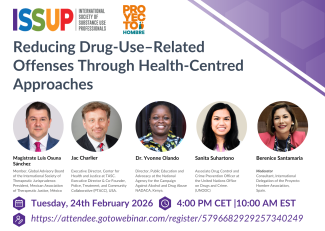
ISSUP Global, in collaboration with Proyecto Hombre, presents a webinar on Reducing Drug-Use–Related Offenses Through Health-Centered Approaches.
Date: Tuesday, 24th February 2026
Time: 4:00 PM CET |10:00 AM EST | 3:00 PM UK
This webinar explores how therapeutic justice offers more effective, humane, and sustainable solutions for reducing drug-use–related offenses in communities. Through a health-centred approach, it will examine how strategies alternative to detention, imprisonment, and coercive sanctions, as well as treatment courts, deflection and pre-arrest diversion, and rehabilitation and reintegration models, help break cycles of criminality associated with problematic substance use. The webinar will present international evidence, conceptual frameworks, and practical experiences demonstrating that addressing drug use as a public health issue, rather than a strictly criminal matter, improves community safety, reduces recidivism, and strengthens social inclusion.
The webinar will be in English and Spanish, with interpretation available via GoToWebinar.
Intended audience:
- Health professionals (physicians, psychologists, social workers)
- Public policy decision-makers in health and justice
- Civil society organisations and NGOs
- Academics and researchers in criminology and public health
- Students of law, psychology, and social sciences
Learning outcomes:
By the end of the webinar, participants will be able to:
-
Understand the fundamental principles of therapeutic justice and their application in drug-use contexts.
-
Analyse how health-centred approaches contribute to reducing drug-related offenses.
-
Identify key strategies such as deflection, diversion, alternatives to incarceration, and treatment courts, and their impact on reducing recidivism.
-
Assess international models that integrate justice and health to improve community safety.
-
Recognise essential elements of rehabilitation and reintegration that strengthen long-term recovery and reduce the burden on policing and judicial systems.
-
Explore opportunities to implement or adapt therapeutic justice approaches within their own institutional or community contexts.
Presenter:
Magistrado Luis Osuna Sánchez
El Magistrado Luis Enrique Osuna Sánchez ha dedicado su carrera a humanizar el sistema jurídico a través de la Jurisprudencia Terapéutica (JT). Es Licenciado en Derecho por la Universidad de Sonora, cuenta con una Maestría en Derecho Fiscal y Financiero con mención honorífica, y una especialización en Derechos Humanos y Justicia Administrativa. Realizó estudios de posgrado en el Center for Alternative Dispute Resolution de la Universidad de La Trobe y es candidato a doctor en la Universidad de Deakin, Australia. Su formación incluye programas en la Universidad Complutense de Madrid, ITAM, IPADE, Tecnológico de Monterrey y el Institute of Arbitrators and Mediators of Australia.
Desde 2015 se desempeña como Magistrado del Tribunal Federal de Justicia Administrativa (TFJA). Es Presidente del Colegio Nacional de Magistrados del TFJA, Vicepresidente de la Asociación Iberoamericana de Jurisprudencia Terapéutica, Presidente de la Asociación Mexicana de Justicia Terapéutica, miembro del Consejo Asesor Global de la Sociedad Internacional de Jurisprudencia Terapéutica y Director Científico de la Fundación Euroamericana-Internacional (2024–2026). Asimismo, es Académico de la Academia Mexicana de Derecho Fiscal, miembro de número de la Barra Mexicana, Colegio de Abogados, miembro titular del Instituto Panamericano de Derecho Procesal y consejero del Consejo Mexicano para la Certificación Profesional en Psicología.
Es autor de libros y artículos sobre derecho administrativo, derechos humanos, salud mental y Jurisprudencia Terapéutica, además de conferencista internacional. Su trayectoria ha sido reconocida con la Medalla al Mérito Académico Pablo Neruda (Colombia, 2024) y distinciones otorgadas por organizaciones jurídicas internacionales. Es reconocido por vincular la investigación rigurosa con la reforma judicial y ha recibido títulos como “Conferencista Internacional Eminente Interdisciplinario” y “Jurista de Mérito”.
Jac Charlier
Jac Charlier ha dedicado su carrera en el ámbito de la justicia a fortalecer la seguridad comunitaria. Su enfoque se centra en la reducción del delito, particularmente el delito callejero relacionado con drogas y la victimización asociada al consumo y tráfico de sustancias. Su trabajo promueve firmemente la prevención, el tratamiento y la recuperación.
Ex Subdirector del Servicio de Libertad Condicional del Estado de Illinois, es un reconocido ejecutivo del sector sin fines de lucro en el ámbito de la justicia. Actualmente es Director Ejecutivo del Center for Health and Justice (CHJ) de TASC, una organización nacional e internacional especializada en soluciones prácticas, locales y colaborativas en la intersección entre la seguridad pública y la salud pública. También es Director Ejecutivo y Cofundador de la Police, Treatment, and Community Collaborative (PTACC), considerada la voz global del campo de la deflexión, y uno de los fundadores de este enfoque a nivel internacional, desarrollando estrategias que articulan a las fuerzas del orden, los servicios de tratamiento y la comunidad para reducir el delito, disminuir el consumo de drogas y promover la recuperación.
Es veterano militar y Eagle Scout. Posee una Licenciatura en Matemáticas por la Universidad de Illinois y una Maestría en Políticas Públicas por The Ohio State University, donde su tesis se centró en las experiencias de las víctimas del delito. Es miembro del consejo directivo de la Illinois Academy of Criminology (IAC).
Dr. Yvonne Olando
La Dra. Yvonne Olando cuenta con más de 15 años de experiencia consolidada en el ámbito de la prevención y el manejo del consumo de sustancias. Es Psicóloga Clínica y Profesional Internacional Certificada en Adicciones (ICAP IV). Es Especialista en Cesación del Tabaquismo (CTTS-MAYO, EE. UU.), Capacitadora Global en Reducción de la Demanda de Drogas (UNODC) y Master Trainer Global del Universal Treatment Curriculum del Colombo Plan. Integra el grupo de expertos de la World Heart Federation en Nicotina, Tabaco, Alcohol y Drogas, es líder de PTACC África y copresidenta de ID&D, además de Comisionada de la Comisión Global de Credenciales y Acreditación del International Consortium of Universities for Drug Demand Reduction (ICUDDR). Fue la primera Secretaria del capítulo de ISSUP en Kenia.
Es Doctora y Magíster en Psicología Clínica por la Universidad de Nairobi, licenciada en Psicología por la Universidad de Moi, y cuenta con un certificado de posgrado en Control Global del Tabaco por la Johns Hopkins Bloomberg School of Public Health (EE. UU.), así como un diploma en estudios sobre dependencia química por SAPTA.
Ha trabajado como consultora para la Organización Mundial de la Salud (OMS-AFRO) como Experta Regional en Cesación del Tabaquismo y para The Colombo Plan como experta en adicciones. Fue docente en el Departamento de Psicología de la Universidad de Nairobi y ha trabajado en centros residenciales de rehabilitación, programas ambulatorios y entornos hospitalarios.
Actualmente es Directora de Educación Pública y Abogacía en la Autoridad Nacional para la Campaña contra el Alcohol y el Abuso de Drogas (NACADA), corporación estatal dependiente del Ministerio del Interior y Administración Nacional.
Sanita Suhartono
Sanita Suhartono is an Associate Drug Control and Crime Prevention Officer at the United Nations Office on Drugs and Crime (UNODC), Prevention, Treatment and Rehabilitation Section. She supports the coordination and implementation of UNODC’s global programmes focused on the treatment and care of drug use disorders.
With a background in international development and public health, she has contributed to the development of key technical tools and initiatives, focusing on increasing quality assurance mechanisms for the treatment of drug use disorders, including strengthened health and justice collaboration to promote drug treatment as an alternative to conviction or punishment.
Since joining UNODC in 2016, she has held positions at headquarters in Vienna and the Regional Office for Eastern Africa, advancing effective approaches and interventions for people who use drugs and with drug use disorders, in line with the International Standards for the Treatment of Drug Use Disorders.
Moderator:
Berenice Santamaría
Berenice Santamaría, Consultant with the International Delegation of the Proyecto Hombre Association (Spain). Master’s degree in Criminal Procedural Law; specialist in drug policy, crime prevention, criminal justice reform, therapeutic justice, and treatment alternatives. Certified in Moral Reconation Therapy (MRT) for drug users in conflict with the law.
References:
Therapeutic Justice and Treatment Courts
-
David B. Wexler & Bruce J. Winick – Judging in a Therapeutic Key: Therapeutic Jurisprudence and the Courts.
-
Wexler, D. B., Oyhamburu, M. S., & Fariña Rivera, F. (2020). Therapeutic Justice: A New Legal Paradigm. Madrid: Wolters Kluwer. In this volume, Fariña authors the chapter “The Cognitive Interview as a Tool of Therapeutic Justice.”
-
West Huddleston – NADCP field reports (e.g., “Painting the Current Picture” series) and leadership in the expansion of treatment courts.
Public Health and International Standards
-
UNODC – International Standards for the Treatment of Drug Use Disorders.
-
EMCDDA – Reports on alternatives to incarceration and program evaluation.
Diversion and Deflection (Police-Led)
-
Jac Charlier – Diversion and deflection frameworks; Co-Founder of PTACC (Police, Treatment, and Community Collaborative); practical guides for deflection to treatment and services.
-
PTACC – Models, tools, and case studies on police-community deflection implementation.
Clinical Training and Substance Use Disorder Treatment
- SAMHSA – Best practice guidelines for treatment and coordination with justice systems.
Webinars and online events delivered and hosted by the International Society of Substance Use Professionals (ISSUP) are provided for informational purposes only. They are educational in nature and do not constitute medical advice, diagnosis or treatment.